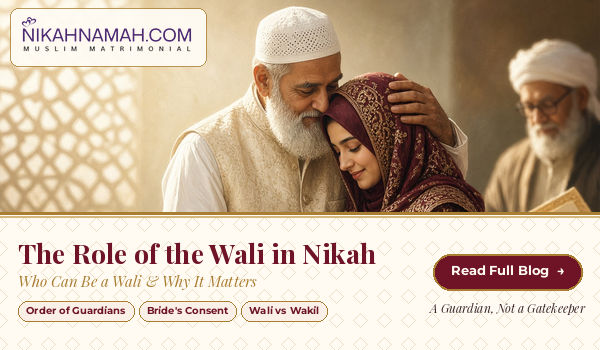
By NikahNamah | India's Most Trusted Muslim Matrimony Platform Since 1999
In most Indian Muslim families, the question of the wali seems simple. Of course the bride's father will be there. Of course he will give her hand in marriage.
Real life is often less simple. A father has passed away, and the family is unsure whether the bride's elder brother or her uncle should act. A sister who embraced Islam has no Muslim relatives at all. A young professional in Dubai wants to marry while her family is in Hyderabad. Or a father refuses a good proposal for reasons that have nothing to do with the groom's deen or character.
This guide explains who the wali is, who can act as one and in what order, how the schools of Islamic law differ, what the wali owes the bride, and what happens when the wali is absent or refuses unreasonably.
Our Nikah process guide introduces the wali as one of the conditions of a Nikah, and our nikahnama clauses guide explains where the wali's name appears in the marriage document. Here we focus on the wali alone. For choosing a partner whose values match your family's, see our article on why compatibility in Nikah matters.
NikahNamah has been a Muslim matrimony platform and marriage bureau since 1999, from our offices in Jayanagar 9th Block and Frazer Town, Bangalore. With 86,000+ successful Nikah and 96,461+ registered members (figures as published on www.nikahnamah.com), we work with fathers, brothers, mothers and guardians every day.
Please note: This article is general guidance for families, not a fatwa. The schools of Islamic law differ on several points about the wali, and the right answer often depends on the specific situation. For your own Nikah, especially if the wali is absent, objecting or not Muslim, please consult a qualified Alim or Mufti.
What Does Wali Mean?
The Arabic word wali comes from a root that carries the meanings of closeness, protection and responsibility. In the context of Nikah, the wali is the bride's guardian: a close male relative who has the responsibility of looking after her interests in the marriage contract.
The wali's role is often misunderstood as ownership or control. It is neither. In Islamic teaching, the wali is entrusted with a duty of care. He is expected to make sure the proposed husband is suitable and that the bride's rights are protected. His authority exists for her benefit, not for his own.
Scholars often cite well-known hadith on this topic, including the narration that there is no Nikah without a wali, and the narration that a woman who has been previously married has more right over herself than her guardian, while a never-married woman's consent must also be sought.
Who Can Be a Wali? The Order of Guardians
The wali is normally drawn from the bride's male relatives on her father's side. The schools set out an order of priority, and while the details differ, the general pattern is similar:
- Her father
- Her paternal grandfather, and further up the paternal line
- Her full brother
- Her paternal half-brother (same father)
- Sons of her brothers (her nephews)
- Her paternal uncles (father's brothers)
- Sons of her paternal uncles (her cousins)
If none of these are available or eligible, guardianship passes to the Islamic authority, traditionally described as the ruler (sultan) or the judge (qadi), or to whoever represents that role in the community.
Where the Schools Differ on the Order
There are differences in the details. For example, some schools, including the Hanafi and Maliki schools in general terms, place a woman's adult son ahead of her father where she has one, as may happen in a second marriage. Schools also differ on ranking relatives of the same level and on when a more distant wali can act. A local Alim can confirm the order your family should follow.
Conditions of a Wali
For a person to act as wali, scholars generally require that he be:
- Muslim, when the bride is Muslim
- Adult
- Of sound mind
- Male, according to the majority view
- Free to act, not under legal restriction
Some schools also emphasise that the wali should be upright in character ('adalah), and some exclude a person who is in the state of ihram for Hajj or Umrah from conducting a Nikah at that time.
The Schools of Thought: Hanafi vs the Majority
This is the area of greatest difference, and it matters for India, where most Muslims follow the Hanafi school and significant communities, especially in Kerala and coastal Karnataka, follow the Shafi'i school.
The Majority View: Maliki, Shafi'i and Hanbali
The Maliki, Shafi'i and Hanbali schools generally treat the wali as a condition for a valid Nikah. In their view, a woman does not conclude her own marriage contract without a wali, and they rely on well-known hadith that there is no Nikah without a wali. A Nikah conducted without the wali or his authorised representative is, in general terms, not valid in these schools.
The Hanafi View
The Hanafi school generally holds that an adult woman of sound mind may contract her own Nikah, and that it is valid without a wali.
However, the Hanafi school does not make the wali irrelevant. It gives the wali the right to object in some situations, for example if the match is clearly unsuitable in terms of kafa'ah (suitability), and Hanafi scholars strongly encourage involving the wali, as is respectful and wise. Some later Hanafi scholars took a stricter position on marriages to an unsuitable match without the wali's approval. Families should ask their own scholars which position they follow.
What This Means in Practice
In everyday Indian practice, almost every Nikah involves the bride's father or guardian, whatever the school. That remains the safest and most harmonious path. It respects the bride's family, satisfies all the schools, and avoids later questions about validity.
The Wali's Duties
Protecting Her Interests
The wali should investigate a proposal sincerely: the groom's deen, character, ability to provide, family background and suitability. He should not let personal gain, family politics or status influence his decision. Our article on verified matrimony profiles explains why checking basic facts is part of this care.
Seeking Her Consent, Never Forcing
A wali cannot impose a marriage on an unwilling woman. Well-known hadith describe the Prophet (peace be upon him) giving a woman the choice to annul a marriage her father had arranged without her agreement. Classical texts contain discussions about a father's authority in the case of a never-married daughter, but scholars across the schools emphasise that her consent should be sought, and forced marriage is a serious wrong.
Securing Her Rights in the Contract
The wali helps ensure the mahr is fair and clearly recorded, that any agreed conditions are written into the nikahnama, and that the bride understands what she is agreeing to. Our Mahr guide and our nikahnama clauses guide cover these points.
The Bride's Consent: Her Right, Not a Formality
Whatever the school, the bride's consent is essential. The wali does not replace it. In practice, the Qazi or a family elder usually asks the bride directly, with witnesses present, whether she accepts the groom on the stated mahr.
Scholars often mention that a previously married woman states her consent clearly in words, while for a never-married woman, quiet acceptance when asked has traditionally been treated as consent. Many scholars today recommend that families seek clear, spoken agreement from every bride, so that there is no doubt.
When a Wali Refuses Unreasonably ('Adl)
Sometimes a wali refuses a proposal that is suitable in every way that matters in Islam: a groom of good deen and character who can provide for her, whom she wishes to marry. Scholars call this unjust prevention 'adl.
The Quran warns against this. In Surah Al-Baqarah (2:232), guardians are told not to prevent women from marrying their husbands when they agree between themselves in a fair manner.
What Happens Then
In general terms:
- First, family reconciliation. Elders, scholars and trusted relatives should try to understand the wali's concerns and resolve them.
- Under the majority view, if the wali persists in refusing without valid reason, his right may pass to the Qazi or Islamic authority, or, in some views, to the next wali in line. Scholars cite the well-known narration that the ruler is the wali of one who has no wali.
- Under the Hanafi view, an adult woman may contract her own Nikah, though the question of suitability (kafa'ah) may still be relevant.
A wali's objection is not always unreasonable. Genuine concerns about the groom's deen or character deserve to be heard. What counts as reasonable, and what steps to take, should be decided with a qualified Qazi or Mufti, not by the couple alone.
The Qazi as Wali
When a woman has no eligible wali, or her wali refuses unjustly, many scholars hold that the Qazi or Islamic authority acts as her wali. In countries without an Islamic government, scholars generally describe this role being filled by a recognised Qazi, an Imam or a council of scholars trusted by the local Muslim community.
In India, families can approach a Qazi office or a respected local Imam. Abroad, Muslims often approach the Imam of a recognised Islamic centre or a recognised Shariah council.
Reverts and Women Without a Muslim Male Relative
Sisters Who Have Embraced Islam
A woman who has embraced Islam may have a loving father and brothers who are not Muslim. According to scholars, a non-Muslim relative cannot act as the Islamic wali of a Muslim woman. A Qazi, Imam or trusted Muslim authority may then act as her wali.
This does not mean her family should be shut out. Out of kindness and good relations, many reverts involve their non-Muslim parents in the wedding, seek their blessing and invite them to celebrate.
Women Living Abroad
An Indian Muslim woman studying or working abroad usually still has a wali in India. She does not need him to travel. A wali can appoint a wakil (representative) to act on his behalf, and in many situations the family wali participates by phone or video while a wakil is physically present. The exact method should be confirmed with the officiating scholar. If no Muslim male relative is reachable, she can approach the Imam of a recognised Islamic centre or a Shariah council in her city.
Documents for Cross-Border Situations
Where a wali's written authorisation or a marriage document needs to be used in another country, it may require attestation or an apostille. In India, the Ministry of External Affairs' online portal for this is e-Sanad. Check the destination country's requirements with its embassy.
Wali vs Wakil: What Is the Difference?
The two words are often confused.
|
Wali |
Wakil |
|
|
Who |
The bride's guardian, usually her father or nearest eligible male relative |
A representative appointed to act for someone |
|
Source of authority |
Islamic law and family relationship |
Appointment by the wali, the bride or the groom |
|
Role in the Nikah |
Gives the bride in marriage, protects her interests |
Conducts the offer or acceptance on behalf of the person who appointed him |
|
Can it be delegated? |
The wali may appoint a wakil |
The wakil acts within the limits he was given |
|
Common example in India |
The bride's father |
A relative or the Qazi conducting the ijab for the bride's side |
In many Indian ceremonies, the Qazi records the bride's consent before witnesses and then presents the offer to the groom on her side's behalf. Families should be clear who is the wali and who is acting as wakil, and the nikahnama should record both where applicable.
The Wali's Role in the Matchmaking Process
The wali's responsibility does not begin at the Nikah ceremony. It begins with the search.
A caring wali:
- Listens to the bride about her priorities, hopes and concerns
- Looks beyond appearances at deen, character and genuine compatibility
- Verifies information rather than relying only on what is said
- Involves the bride's mother and family, whose insight is often invaluable
- Supports chaperoned conversations so the couple can get to know each other within Islamic limits
- Communicates decisions respectfully, whether the answer is yes or no
When the wali is involved early, the proposal reaches the Nikah with his informed blessing rather than meeting resistance at the final stage.
How NikahNamah Involves Families
We are a matrimony service, not a fatwa service, so questions of rulings belong with your scholars. What we can do is make the wali's role easier.
Our premium members get a dedicated Relationship Manager who:
- Works with parents and guardians directly - fathers, mothers, brothers and other walis can register or join the search
- Shares verified profiles - a small, considered shortlist, with family permission
- Arranges family introductions first - walis and parents speak before any conversation between the couple
- Guides chaperoned conversations - with a parent, sibling or mahram present
- Helps families discuss practical matters - mahr, residence, work and expectations, respectfully
- Hosts family meetings - at our Jayanagar 9th Block or Frazer Town offices if you wish
- Supports istikhara and the final answer - communicated with dignity on both sides
Profiles are manually verified, female members control their photo visibility, registration is free, and every step follows a 100% halal process. We are not a dating app. Read more about personalized matchmaking for Nikah, or register free when your family is ready.
Frequently Asked Questions
Q1: Who can be a wali in Nikah?
Usually the bride's father, then her paternal grandfather, full brother, paternal half-brother, nephews, paternal uncles and their sons, in an order the schools describe with some differences. The wali should be Muslim, adult and of sound mind.
Q2: Is a Nikah valid without a wali?
The Maliki, Shafi'i and Hanbali schools generally say no. The Hanafi school generally allows an adult woman to contract her own Nikah, while giving the wali some rights to object. Please ask a qualified Mufti about your specific case.
Q3: Can a wali force a woman to marry?
No. Her consent is essential, and hadith describe a woman being given the choice to annul a marriage arranged without her agreement. A wali's role is to protect her interests, not to override her will.
Q4: What if my wali refuses a good proposal?
First seek reconciliation through elders and scholars. If the refusal is unjust, many scholars hold that the right may pass to the Qazi or the next wali. Consult a qualified Qazi or Mufti before taking any step.
Q5: Who is the wali for a woman who has embraced Islam?
A non-Muslim relative cannot act as her Islamic wali, so a Qazi, Imam or trusted Muslim authority usually acts. She can still involve her family warmly in the wedding.
Q6: Can my wali take part if he is in another country?
Yes. He can appoint a wakil to act for him, and the method should be confirmed with the officiating scholar.
Q7: What is the difference between a wali and a wakil?
The wali is the bride's guardian by Islamic law and family relationship. A wakil is a representative appointed to act on someone's behalf, such as conducting the offer for the bride's side.
Q8: How do we contact NikahNamah?
Call or WhatsApp +91 98451 30331 or +91 90360 22522, email support@nikahnamah.com or info.nikahnamah@gmail.com, or register at www.nikahnamah.com. Our hours are Monday to Sunday, 10:00 AM - 8:00 PM IST (Friday Off).
Closing Reflection: A Guardian, Not a Gatekeeper
The wali is one of the quiet protections Islam builds into marriage. At his best, he asks the hard questions so the bride does not have to, and stands beside her on the day of her Nikah with love and pride.
May Allah guide every wali to fulfil his trust with wisdom and kindness, grant every bride a marriage of honour and peace, and fill every home with sakinah, mawaddah and rahmah. Ameen.
Register today: www.nikahnamah.com
Call / WhatsApp: +91 98451 30331 | +91 90360 22522
Email: support@nikahnamah.com | info.nikahnamah@gmail.com
Also Read
- The Importance of Compatibility in Nikah
- Why Verified Matrimony Profiles Make Nikah Safer and Easier
- Benefits of Choosing a Personalized Matchmaking Platform for Nikah
- Marriage Beyond Borders: Connecting Muslim Families Worldwide
- How Families Can Choose the Right Muslim Matrimony Platform
- Muslim Matrimony for Doctors, Engineers and Professionals
About NikahNamah
NikahNamah is India's trusted Muslim matrimony platform and marriage bureau since 1999, combining the personal care of a Bangalore marriage bureau with online reach across India and the diaspora.
We offer personal Relationship Manager matchmaking, manually verified profiles, photo privacy for women, free registration and a 100% halal process from registration to Nikah, with 86,000+ successful Nikah and 96,461+ registered members (figures as published on www.nikahnamah.com).
Office and Contact
Main Branch: Jayanagar 9th Block, Bengaluru - 560069
Other Branch: Frazer Town, Bengaluru - 560005
Phone / WhatsApp: +91 98451 30331 | +91 90360 22522
Email: support@nikahnamah.com | info.nikahnamah@gmail.com
Website: www.nikahnamah.com
Office Hours: Monday to Sunday, 10:00 AM - 8:00 PM IST (Friday Off)
Service Area: All India | UAE | Saudi Arabia | Qatar | Kuwait | Bahrain | Oman | UK | USA | Canada | Australia | South Africa

💬 Comments