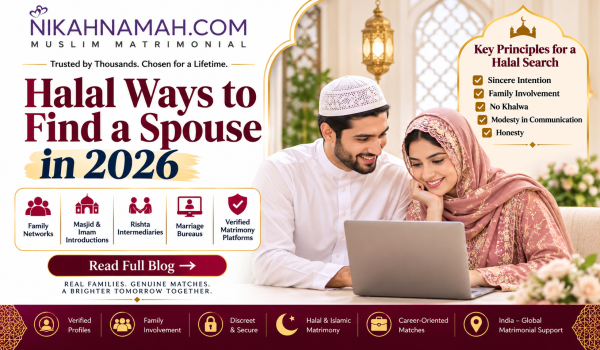
By NikahNamah | India's Most Trusted Muslim Matrimony Platform Since 1999
A generation ago, most rishtas in Indian Muslim families came through a short chain of trusted people: an aunt who knew a family in the next town, an Imam who knew who was looking, a neighbour with a nephew. Today the chain can stretch across apps, video calls, WhatsApp groups and continents.
The good news is that Islam does not prescribe a single method for finding a spouse. What it sets out are principles: sincere intention, honesty, family involvement and avoiding situations that lead to harm. Any route that keeps to those principles can be a halal route, whether it starts at a masjid in Bangalore or on a verified platform used by a family in Dubai.
This guide walks through the main routes Muslim families use in 2026, what makes each one halal or not, how to stay safe online, and a simple step-by-step plan for the search.
Our live articles on how families can choose the right Muslim matrimony platform and on verified matrimony profiles go deep into evaluating a platform and its verification. This article steps back and looks at every route, online and offline, and how to combine them. Our guide to choosing a spouse according to the Sunnah covers what to look for in a person, and our guide to 20 questions to ask before saying qubool covers what to ask once you have a proposal.
NikahNamah has been a Muslim matrimony platform and marriage bureau since 1999, from our offices in Jayanagar 9th Block and Frazer Town, Bangalore. With 86,000+ successful Nikah and 96,461+ registered members (figures as published on www.nikahnamah.com), we have seen rishtas begin in almost every way imaginable, and the ones that go well share the same principles.
Please note: This article is general guidance for families, not a fatwa. Where it touches on Islamic rulings, such as communication before Nikah or the role of the wali, scholars differ on some details. For your own situation, please consult a qualified Alim or Mufti.
What Makes a Route Halal?
Before looking at specific routes, it helps to be clear about the principles that make any search halal.
1. Sincere Intention of Marriage
The search should be for Nikah, not for casual company, entertainment or emotional attachment without commitment. Both people, and ideally both families, should understand that the purpose of any conversation is to decide whether to marry.
2. Family Involvement
Islam treats marriage as a matter that concerns families, and for the bride, the wali has an important role. Our guide to the role of the wali explains how the schools view this. In practice, involving parents or guardians early protects both people, brings experience into the decision, and keeps the process accountable.
3. No Khalwa
Scholars widely hold that a man and woman who are not married should not be alone together in private. This applies before Nikah, including during the search. Conversations should take place with a mahram present or nearby, or in a setting where family is aware and involved.
4. Modesty in Communication
Communication should be purposeful and respectful. Scholars generally caution against long, private, emotionally intimate chats between prospective spouses before Nikah, even when the intention is marriage. The details vary, so it is worth asking a scholar how your family should approach messaging.
5. Honesty
Profiles, introductions and conversations should be truthful. Misrepresenting age, education, work, marital status or health is a form of deception, and it undermines the trust a marriage needs.
A route that keeps these five principles is generally on safe ground. A route that breaks them, however convenient, carries real risk.
Route 1: Family and Community Networks
The oldest route remains one of the most reliable. Parents, grandparents, uncles, aunts, cousins and family friends often know families of good character, and they can share information that no profile ever will: how a family treats its daughters-in-law, how a young man behaves with his parents, whether a household is honest in its dealings.
Strengths: Built-in trust, easy verification through people who know both sides, and natural family involvement.
Limits: Networks can be small, may favour the same few families, and sometimes carry pressure to accept a proposal to avoid offending a relative.
Tips:
- Tell trusted relatives clearly what you are looking for, with deen and character first.
- Be willing to say a respectful no, even to a relative's suggestion.
- Do not rely only on reputation; still meet, ask questions and verify key facts.
Route 2: Masjid and Imam Introductions
Imams and masjid committees often know which families in their community are looking for a spouse. A respected Imam can introduce two families, vouch for character he has observed, and sometimes help both sides through the first conversations.
Strengths: A trusted, religious intermediary; introductions grounded in deen; local knowledge.
Limits: Depends on the Imam's time and network; may be limited to one locality or community.
Tips:
- Approach the Imam through your father, wali or a family elder where possible.
- Share a short, honest summary of the person and the family.
- Remember the Imam is introducing, not guaranteeing; families still need to make their own enquiries.
Route 3: Trusted Rishta Intermediaries
In many Indian cities, certain individuals, often known informally as "rishta aunties" or community matchmakers, are well known for connecting families. Many are sincere and experienced, and some have helped generations of families.
Strengths: Personal knowledge of families, experience in handling sensitive conversations, and a respected go-between.
Limits: Quality varies widely. Some intermediaries share profiles and photos without consent, exaggerate details, or press families to decide quickly.
Tips:
- Choose someone known and trusted by families you know.
- Ask how they will share your details and photos, and with whom.
- Verify what you are told rather than relying only on the intermediary's word.
- If money is involved, agree terms clearly and in writing before you begin.
Route 4: Marriage Bureaus
A marriage bureau combines the personal touch of an intermediary with a larger network and a more structured process. Good bureaus meet families in person, understand their priorities, and arrange introductions with care.
Strengths: Structured process, wider pool, offline meetings, and experienced staff who understand family dynamics.
Limits: Standards vary between bureaus. A bureau is only as good as its honesty, its verification and its respect for privacy.
Tips:
- Visit the office, meet the people, and ask how they verify profiles.
- Ask how they protect women's privacy and photos.
- Check how they involve families and whether introductions are chaperoned.
Route 5: Verified Matrimony Platforms vs Dating Apps
Online platforms are now a major route for Muslim families, especially for professionals and NRIs. But not all online spaces are the same, and the difference matters.
|
Verified matrimony platform |
Dating app |
|
|
Purpose |
Marriage |
Often casual or open-ended |
|
Family role |
Parents can register and take part |
Usually individual only |
|
Verification |
Profiles checked by the platform |
Usually minimal |
|
Photo control |
Women can restrict who sees photos |
Photos usually public to users |
|
Communication |
Structured, family-aware |
Private, one-to-one chat |
|
Fit with Islamic etiquette |
Designed for it |
Generally not designed for it |
Some apps market themselves to Muslims while working much like dating apps. The name of an app matters less than how it works: whether it supports family involvement, verification, privacy and a clear marriage intention. Our article on choosing the right platform, linked above, gives a detailed checklist.
Route 6: Community Events and Gatherings
Islamic conferences, community iftars, charity events, study circles and family weddings are natural places where families meet.
Strengths: You see people and families in real settings, behaving naturally.
Limits: Not designed for introductions, and approaching someone directly at an event can be uncomfortable or inappropriate.
Tips:
- If you notice a family you would like to know, let your parents or an elder make the approach.
- Avoid exchanging private numbers directly between the prospective bride and groom.
- Some communities hold organised marriage events with family participation and clear etiquette; these can be helpful if well run.
Route 7: Cross-Border and NRI Searches
Many Indian Muslim families now search across countries, with a groom in the Gulf and a bride in Hyderabad, or a family in India and a candidate in the UK or Canada. These searches combine several routes: family networks on both sides, platforms and video calls.
The core principles stay the same, but distance makes verification and family involvement even more important. Our article on cross-border Muslim marriage covers time zones, relocation and verification in detail.
Video Calls With a Mahram Present
Video calls have made long-distance and busy-schedule searches much easier. They can be fully in keeping with Islamic etiquette when handled well:
- A mahram or parent should be present on the call or in the room, within sight and hearing.
- Families speak first. Let parents or walis have the first call before the couple talk.
- Keep calls purposeful. Plan the themes you want to cover, rather than open-ended chatting late at night.
- Dress and setting should be modest, as they would be for an in-person family meeting.
- No recording or screenshots without the clear consent of everyone involved.
- Move to an in-person family meeting when possible before any final decision.
Scholars differ on some details of communication before Nikah, so ask your own scholar how your family should approach calls and messaging.
Privacy and Photo Control
Privacy is part of modesty, and it is also part of safety.
- Women should control who sees their photos. On NikahNamah, female members decide their own photo visibility.
- Share contact details only after families agree to take a proposal forward.
- Avoid posting full personal details publicly, including on social media groups, such as address, workplace and daily routine.
- Ask intermediaries and bureaus how your information will be stored and shared.
Online Safety: Scam Red Flags
Some people use matrimony spaces to deceive or exploit. We do not quote statistics here, but the warning signs are well known:
- Requests for money for any reason, such as a medical emergency, a customs fee, a visa problem or an investment opportunity
- Refusal to involve family, or a story about why parents "cannot" be contacted
- Pressure to move quickly to private apps, or to keep the conversation secret
- Reluctance to appear on video, or always having an excuse for poor connection
- Photos that look professionally styled or that appear elsewhere online under other names
- Claims of overseas wealth or status that cannot be confirmed
- Inconsistent stories about work, family or location
- Requests for intimate photos or private calls, which no sincere prospective spouse would ask for
If you see these signs, stop the conversation, inform your family, report the profile to the platform, and where there has been fraud or threats, report it to the police. Never send money to someone you have not met through a verified, family-involved process.
A Step-by-Step Plan for Your Search
- Set your intention and pray. Begin with sincere intention and dua for a spouse of good deen and character.
- Agree priorities as a family. Discuss what matters most, guided by the Sunnah, and what is flexible. Our guide to choosing a spouse according to the Sunnah can help.
- Prepare an honest profile. Accurate age, education, work, family details and marital status, with a clear photo shared only with permission.
- Choose two or three routes. For example, family networks, a trusted Imam and one verified platform or bureau.
- Let families make the first contact. Parents or walis speak first and decide whether to take a proposal forward.
- Verify key facts. Confirm identity, education, work and marital status through reliable means.
- Hold chaperoned conversations. In person or on video, with a mahram present, covering the questions that matter. Our guide to 20 questions to ask before saying qubool offers a framework.
- Arrange a family meeting. Meet in person where possible, at a home or a neutral, appropriate setting.
- Consult and pray istikhara. Seek advice from trusted people, then pray istikhara. Our istikhara guide explains how.
- Give a respectful answer. Whether yes or no, communicate it with dignity and within a reasonable time.
How NikahNamah Fits Into Your Search
We are one route among several, and many of our families also use their own networks and community introductions. What we offer is a structured, family-centred and verified way to widen your search without stepping outside Islamic etiquette. Our premium members get a dedicated Relationship Manager who:
- Understands your family - your deen, values and priorities before suggesting anyone
- Shares verified profiles - a small, considered shortlist, with family permission
- Arranges family introductions first - parents and walis speak before the couple
- Guides chaperoned conversations - in person or on video, with a parent, sibling or mahram present
- Protects your privacy - female members control their photo visibility, and details are shared only with consent
- Hosts family meetings - at our Jayanagar 9th Block or Frazer Town offices if you wish
- Supports the final answer - communicated with dignity on both sides
Registration is free, and every step follows a 100% halal process. We are not a dating app. Read more about personalized matchmaking for Nikah, or register free when your family is ready.
Frequently Asked Questions
Q1: What are halal ways to find a spouse?
Family and community networks, Imam introductions, trusted intermediaries, marriage bureaus and verified matrimony platforms, as long as the search keeps sincere intention, family involvement, honesty and no khalwa.
Q2: Is using a matrimony app halal?
It can be, if the platform is built for marriage, supports family involvement, verifies profiles and protects privacy. An app that works like a dating app is a different matter.
Q3: Can we talk on video before Nikah?
Many families do, with a mahram present and the conversation kept purposeful. Scholars differ on some details, so ask your scholar.
Q4: Should the bride and groom message each other directly?
Scholars generally caution against long private chats before Nikah. Many families keep communication family-aware. Please consult a qualified Alim or Mufti.
Q5: How can I tell if a profile is a scam?
Watch for requests for money, refusal to involve family, pressure for secrecy, avoiding video calls, and inconsistent stories. Report concerns to the platform and your family.
Q6: Is approaching someone at a community event allowed?
It is better for parents or an elder to approach the other family through proper channels, rather than the prospective bride or groom approaching each other directly.
Q7: How many routes should we use at once?
Two or three well-chosen routes usually work better than many scattered ones. Be honest with each family you speak to and do not keep anyone waiting unnecessarily.
Q8: How do we contact NikahNamah?
Call or WhatsApp +91 98451 30331 or +91 90360 22522, email support@nikahnamah.com or info.nikahnamah@gmail.com, or register at www.nikahnamah.com. Our hours are Monday to Sunday, 10:00 AM - 8:00 PM IST (Friday Off).
Closing Reflection: New Routes, Timeless Principles
The ways families meet will keep changing. The principles will not. Sincere intention, honest information, family involvement and modesty in communication turn any route, old or new, into a path that is pleasing to Allah.
May Allah guide every sincere seeker to a spouse of deen and good character, protect them from deception, and fill their homes with sakinah, mawaddah and rahmah. Ameen.
Register today: www.nikahnamah.com
Call / WhatsApp: +91 98451 30331 | +91 90360 22522
Email: support@nikahnamah.com | info.nikahnamah@gmail.com
Also Read
- How Families Can Choose the Right Muslim Matrimony Platform
- Why Verified Matrimony Profiles Make Nikah Safer and Easier
- Marriage Beyond Borders: Connecting Muslim Families Worldwide
- Benefits of Choosing a Personalized Matchmaking Platform for Nikah
About NikahNamah
NikahNamah is India's trusted Muslim matrimony platform and marriage bureau since 1999, combining the personal care of a Bangalore marriage bureau with online reach across India and the diaspora.
We offer personal Relationship Manager matchmaking, manually verified profiles, photo privacy for women, free registration and a 100% halal process from registration to Nikah, with 86,000+ successful Nikah and 96,461+ registered members (figures as published on www.nikahnamah.com).
Office and Contact
Main Branch: Jayanagar 9th Block, Bengaluru - 560069
Other Branch: Frazer Town, Bengaluru - 560005
Phone / WhatsApp: +91 98451 30331 | +91 90360 22522
Email: support@nikahnamah.com | info.nikahnamah@gmail.com
Website: www.nikahnamah.com
Office Hours: Monday to Sunday, 10:00 AM - 8:00 PM IST (Friday Off)
Service Area: All India | UAE | Saudi Arabia | Qatar | Kuwait | Bahrain | Oman | UK | USA | Canada | Australia | South Africa

💬 Comments