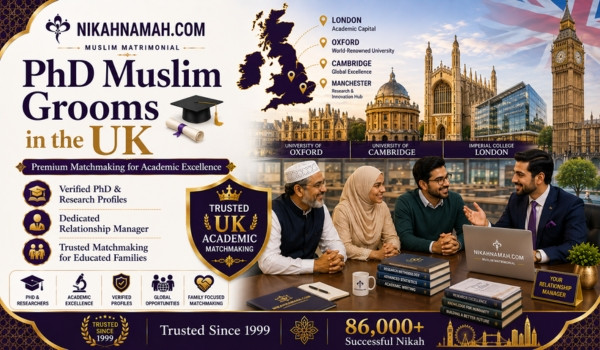
By NikahNamah | India's Most Trusted Muslim Matrimony Platform Since 1999
There is a specific, distinguished, and genuinely underserved cohort within the UK's Indian Muslim professional matrimony landscape - one that most guides overlook because it sits in an unusual position: academically among the most accomplished Indian Muslims anywhere in the world, and yet in a practical financial situation that creates a specific, important challenge that families in India rarely understand until it is explained clearly.
Indian Muslim PhD students and early-career academics at the UK's Russell Group universities - at Oxford, Cambridge, Imperial, UCL, Manchester, Birmingham, Leeds, Sheffield, Nottingham, and their colleagues across the 24-university Russell Group - represent a remarkable achievement. At the UK postgraduate level, only 8.7% of students identify as Muslim, and Muslims are the smallest faith group as a proportion of Russell Group institutions - meaning the Indian Muslim PhD student at a Russell Group university occupies a genuinely elite, statistically uncommon position within UK higher education. The Oxford Centre for Islamic Studies, which specifically funds DPhil students conducting Islamic studies research within the University of Oxford, is a further, specific example of the high-achievement ceiling this community reaches.
And yet this same groom - completing a DPhil at Oxford, conducting biomedical research on a UKRI scholarship at Imperial, or in the third year of a PhD in computer science at Manchester - faces a specific, critical matrimony reality that most families in India discover only when it is too late to have changed their planning:
A UK PhD stipend, typically around £18,000-£19,000 per year at UKRI rates, is substantially below the £29,000 per year minimum income threshold required to sponsor a spouse visa in the UK.
This single fact - critical, specific, and rarely proactively communicated by general matrimony services - is the foundation of this guide. Everything else about the PhD Muslim groom's matrimony search in the UK flows from understanding it correctly, and planning around it deliberately.
Who UK PhD Muslim Grooms Are - The Academic Achievement Context
The Russell Group - What It Means to Be There
The 24 Russell Group universities represent the UK's research-intensive elite - the universities whose research output, global rankings, and graduate employment records make them the UK equivalent of the US Ivy League for most practical purposes. Oxford (consistently first or second globally) and Cambridge (first or second alongside Oxford), alongside Imperial College London, UCL, the London School of Economics, and the broader Russell Group, represent the destinations where the most competitive international doctoral students in the world converge.
For an Indian Muslim to be conducting a PhD at one of these institutions represents a specific, demanding achievement: a bachelor's degree with high distinction, a master's degree or equivalent research experience, competitive application through UKRI funding competitions or college scholarship processes, and the intellectual and research profile that Russell Group supervisors and funding bodies recognise as worth investing in. This is not the mainstream university experience - it is the academic achievement ceiling.
Within this elite group, the Oxford Centre for Islamic Studies (OCIS) deserves specific mention: a PPU (Permanent Private Hall) of the University of Oxford, focusing on the scholarly study of the Muslim world, which awards DPhil scholarships specifically to Muslim scholars. An Indian Muslim studying on an OCIS scholarship at Oxford is at the intersection of elite UK academic achievement and genuine Islamic scholarly commitment in a way that is genuinely uncommon and deserves to be presented to families as the distinguished position it is.
The PhD Journey's Specific Character
A UK PhD is typically three to four years of full-time research - a funded scholarship (in STEM subjects, social sciences, and increasingly humanities) covering tuition fees and a living stipend, during which the doctoral researcher conducts original research, writes a thesis, and develops into an independent academic or research professional. The UKRI stipend rate for 2025-26 is approximately £18,622 per year - a figure that covers London or UK city living adequately for a single person but is not a commercial professional's salary.
For Indian Muslim PhD grooms specifically, the journey involves a further dimension beyond the academic work itself: maintaining Islamic practice and identity within a UK university environment where Muslim doctoral students are statistically underrepresented (8.7% of postgraduates UK-wide), where university social culture is often centred on alcohol-adjacent activities, and where the prayer and halal food infrastructure varies significantly between a large city like London and a smaller university town like Oxford or Canterbury.
The Academic Career Fork - What Comes After the PhD
For families in India evaluating a PhD groom's proposal, one of the most important questions to engage with specifically is: what happens after the PhD? The two most common trajectories carry genuinely different income and lifestyle implications:
The academic career path: Postdoctoral fellowship (typically £35,000-45,000/year), followed by lecturer position (£42,000-55,000 at most UK universities, rising with experience and promotion), then senior lecturer, reader, and professor. This path keeps the groom within the university world - with its specific culture of intellectual independence, research freedom, and career structures tied to publication records and grant success. It can involve geographic mobility (moving to wherever a postdoc or lectureship is available), which has specific matrimony implications.
The industry transition path: After completing the PhD, moving into corporate R&D, technology, consulting, financial services, or other professional sectors where a research doctorate commands premium salaries - often £55,000-80,000+ for STEM PhDs entering industry in London. This path transitions to a more conventional professional-salary picture significantly faster than the academic path.
For matrimony purposes, which path the groom is pursuing - and how far along it he is - matters significantly for the financial picture families are evaluating, and should be communicated specifically from the first conversation.
The Critical Spouse Visa Reality - What No One Tells Families Early Enough
The £29,000 Income Threshold and the PhD Stipend Gap
This deserves its own section, stated clearly, because the gap between the typical PhD stipend and the UK spouse visa income requirement is large and consequential:
The UK's partner/spouse visa (Family Visa) requires the sponsoring partner to demonstrate a minimum income of £29,000 per year as of April 2025 - up from the previous £18,600 threshold. This requirement applies to British citizens and persons with settled status (Indefinite Leave to Remain).
A UK PhD stipend of approximately £18,622 per year is roughly £10,000 below this threshold.
This means: a PhD groom who is an Indian national on a student visa cannot sponsor a spouse to join him in the UK at all during his PhD, regardless of his visa category. And a PhD groom who holds British citizenship or ILR (if he is a British-born/settled Indian Muslim rather than a recent migrant) may still fall below the income threshold if his stipend is his primary income source.
This is the central, practical reality that premium matrimony for UK PhD grooms must address honestly and proactively - not as a reason to disqualify every PhD groom, but as a specific planning reality that shapes how the matrimony search should be structured and timed.
What This Means in Practice
If the PhD groom is an Indian national on a student/PhD visa: He cannot sponsor a spouse to join him in the UK during the PhD period at all - his visa category does not permit family sponsorship in the way that a work visa or settled status would. A matrimony conducted during the PhD would, realistically, involve the couple being in different countries until the groom's immigration status changes (to post-PhD employment with qualifying salary) or until he obtains ILR/citizenship through another route.
If the PhD groom holds British citizenship or ILR: He can technically apply to sponsor a spouse, but the £29,000 income threshold means his stipend alone falls short. Additional income sources - teaching assistantships, tutoring, savings above the threshold - may supplement this, but the family visa application would need to demonstrate the qualifying income specifically. This is possible but requires specific planning and potentially documentation that a standard stipend holder doesn't have.
After PhD completion - the Graduate Route Visa pathway: A PhD graduate from a UK university is eligible for the Graduate Route Visa (3 years for PhD graduates, compared to 2 years for other degrees) - during which they can work freely in the UK without employer sponsorship. As the groom transitions to a postdoctoral, industry, or other professional role post-PhD, his income typically rises toward and above the £29,000 threshold within the first year - at which point, if he holds British citizenship or ILR, the spouse visa pathway becomes clearly achievable.
Planning Around This Reality - Not Against It
The honest implication for families: a PhD groom in the middle of his doctoral research represents an excellent long-term prospect whose immediate practical sponsorship picture is limited. The right family approach is to engage with the complete picture - current stipend, current visa category, realistic post-PhD timeline to qualifying income, and the specific long-term trajectory - rather than either dismissing the proposal because of the current stipend or discovering the visa reality only after the Nikah has taken place.
The PhD Muslim groom who presents this complete, honest picture - including the post-PhD trajectory and timeline - is demonstrating exactly the kind of intellectual and personal honesty that makes him a distinguished candidate, not a problematic one.
What Premium Matrimony Provides for PhD Muslim Grooms
Presenting the Complete Academic Trajectory, Not Just the Current Stipend
A premium matchmaking service serving PhD Muslim grooms communicates the full academic picture to India-side families: current stipend (honest figure), current visa category and its implications, expected PhD completion timeline, post-PhD trajectory (academic or industry), and the realistic income and sponsorship picture at each stage. This complete, sequenced picture - not the current stipend alone, but the whole journey it is part of - is what enables families to make informed decisions.
Finding Families Who Understand Academic Life
The right family for a PhD groom is one that genuinely understands and values academic achievement rather than treating it as a lesser-income alternative to commercial professional success. This is not universal even among educated Indian Muslim families - some families whose primary reference for success is commercial salary find the academic life's income trajectory, geographic mobility requirements, and publication-cycle pressures genuinely difficult to appreciate, and this mismatch, when it occurs, produces real post-marriage friction.
Premium matchmaking specifically seeks families where this understanding - of academic culture, the value of research credentials, and the specific rhythms of a doctoral and post-doctoral life - is genuinely present rather than merely stated.
The Geographic Mobility Question
Academic careers in the UK - particularly at the postdoctoral level - frequently require geographic mobility: a postdoc position may be at a university in a different city from where the PhD was conducted, and early academic careers often involve one or two moves before a permanent lecturer position is secured. For a bride joining a UK academic, this potential mobility is a real, specific consideration that deserves honest acknowledgment and compatibility discussion - the right partner is one who finds the intellectual and community richness of different UK university towns genuinely interesting rather than an unwelcome disruption.
Verified Academic Credentials - University-Level Confirmation
PhD enrolment and completion can be verified through university registration records and, upon completion, through degree certificates confirmed by the awarding institution. Premium matchmaking for this cohort goes beyond self-reported academic credentials to confirm that the PhD position, university affiliation, and funding status are genuinely as described - providing families with the same level of credential verification appropriate to this distinguished academic category.
Real Stories: UK PhD Muslim Grooms and NikahNamah
Story 1: The Oxford DPhil Student - When the Stipend and Visa Reality Changed the Strategy
Tariq, 27, was a DPhil student at Oxford - biological sciences, third year, BBSRC-funded scholarship, from a Hyderabad Muslim family. His family had been informally searching and had encountered two families in India who had initially expressed strong interest - "Oxford PhD, very impressive" - and then quietly withdrawn when, in separate conversations, they learned that Tariq's stipend was approximately £19,000/year and that his student visa category did not permit him to sponsor a spouse.
NikahNamah's Relationship Manager restructured the approach entirely. Rather than presenting Tariq's profile to families who might assume a commercial professional salary, she specifically sought families who understood academic career trajectories - whose own backgrounds in medicine, academia, or research gave them a genuine frame of reference for why a funded DPhil at Oxford was, despite the stipend, an extraordinarily distinguished position with a clear trajectory to a significantly higher income post-PhD. She presented the timeline explicitly: PhD submission expected in fourteen months, post-PhD postdoc or industry role in biological sciences in London typically paying £45,000-70,000+ within eighteen months of submission.
"Two families had withdrawn once the practical picture emerged, because they'd assumed Oxford meant a professional salary," Tariq's father said. "The RM found families who understood academic life specifically - who knew what a BBSRC-funded Oxford DPhil actually meant in terms of career trajectory - and the conversation with those families was completely different from the start."
The match was from a Hyderabad family whose father was a university professor - immediate, intuitive understanding of the academic career path, the stipend as the current phase of a well-funded distinguished programme, and the post-PhD trajectory with genuine confidence.
Story 2: The Manchester Computer Science PhD - When Industry Transition Was the Right Frame
Yusuf, 29, was completing his PhD in machine learning at the University of Manchester - fourth year, scholarship-funded, from a Bengaluru Muslim family. His plan after the PhD was explicitly industry rather than academia: a machine learning engineer or data science role in London, where his specific research specialism commanded salaries of £65,000-90,000+ for PhD-qualified professionals. His Graduate Route Visa (3 years for PhD graduates) meant he had a clear, defined post-PhD period to establish this professional transition.
His family's challenge was presenting this industry-transition picture to families in India clearly enough that the PhD current situation and the industry post-PhD future were both understood as parts of one coherent story rather than as a bait-and-switch where "Manchester PhD" turned out to mean "not yet earning a commercial salary."
NikahNamah's Relationship Manager built this as an explicit, two-phase presentation: current PhD (stipend, Manchester, machine learning research specialism), and post-PhD trajectory (Graduate Route Visa, London industry transition, specific salary range for ML PhDs in London industry, timeline). She confirmed this picture was accurate by engaging directly with Yusuf's own realistic assessment of his industry prospects - not promotional framing, but his own honest assessment backed by Manchester's own placement records for ML PhD graduates.
"The RM helped us present both phases as one story rather than separately," Yusuf said. "Families who understood the full picture engaged with it as a strong, specific, well-planned trajectory. The one who became our match had a cousin who'd done exactly this transition - UK STEM PhD to London industry - and understood it directly."
Story 3: The Imperial Academic - When the Academic Path Was Presented With Pride
Dr. Imran, 31, had completed his PhD at Imperial College London in chemical engineering and was now a postdoctoral research fellow - salary £42,000/year, visa converted from student to Skilled Worker, on a clear academic promotion track toward a lectureship within two to three years. His family's search had been hampered by a reluctance to describe his postdoc as anything other than "he's working in London at Imperial" - partly because the family themselves were uncertain how academic career progression was understood by Indian families.
NikahNamah's Relationship Manager reframed the presentation with specific confidence: a postdoctoral research fellowship at Imperial College London in the top ten globally for engineering, £42,000 current salary on a Skilled Worker visa (above the £29,000 spouse visa threshold, making the sponsorship picture clear and achievable), and a realistic academic promotion trajectory to lecturer within two to three years. She specifically sought families who would understand the Imperial College credential as the distinction it was rather than reading "postdoctoral researcher" as "not yet a permanent job."
"We'd been underselling his position because we weren't sure how 'postdoc at Imperial' landed with families," Dr. Imran's father said. "The RM said: present it with the full confidence it deserves - this is one of the world's top ten engineering universities, he's already above the spouse visa threshold, and the trajectory to a permanent academic post is realistic. The families who understood that were exactly right."
Testimonials: UK PhD Muslim Grooms on NikahNamah
"Two families withdrew when the stipend and visa reality emerged. NikahNamah found families who understood Oxford DPhil specifically - the career trajectory was the frame, not the current stipend." - DPhil Student, University of Oxford
"NikahNamah helped us present both the PhD phase and the post-PhD industry trajectory as one coherent story. The family who said yes had direct experience of exactly this transition." - PhD Student, University of Manchester
"We'd been underselling his postdoc position. NikahNamah said: present it with the full confidence the Imperial credential deserves. The families who understood that were exactly right." - Father of Postdoctoral Fellow, Imperial College London
"NikahNamah understood the PhD Muslim groom's specific situation - the stipend-below-visa-threshold reality, the academic versus industry trajectory fork, the Graduate Route Visa window, and the specific intellectual compatibility that academic life requires. That understanding is what premium matrimony means." - Indian Muslim PhD Groom, Russell Group University
How NikahNamah's Premium Service Serves UK PhD Muslim Grooms
We communicate the stipend-versus-visa-threshold reality proactively and specifically. The £29,000 UK spouse visa income requirement versus the ~£18,622 UKRI PhD stipend is a critical, specific gap that families in India must understand before serious interest develops - not discover mid-process or after the Nikah.
We present the complete academic trajectory, not the current stipend alone. PhD funding, expected completion timeline, post-PhD visa options (Graduate Route Visa, 3 years for PhD graduates), and realistic income at each stage - communicated as a complete, coherent picture that enables informed family decisions.
We seek families with genuine understanding of academic life. For PhD grooms, the right family is one that understands and values the academic career path specifically - and premium matchmaking actively searches for this understanding rather than assuming it is present in every educated Indian Muslim family.
We engage with the academic versus industry fork honestly. Families deserve to know whether a PhD groom is pursuing an academic career (postdoc → lecturer, with associated income trajectory and geographic mobility) or planning an industry transition (Graduate Route Visa → London tech/consulting, with associated salary timeline) - because these are genuinely different life plans.
We serve PhD grooms across the UK's Russell Group geography. London (UCL, King's, Imperial, Queen Mary), Manchester, Birmingham, Leeds, Sheffield, Nottingham, Cambridge, Oxford, Edinburgh - each university city with its own specific character, Muslim community infrastructure, and matrimony context.
For Families in India: The Complete UK PhD Picture
A PhD stipend is typically £18,000-19,000/year - substantially below the £29,000 UK spouse visa threshold. Families must understand this before any emotional investment develops in a match where immediate UK co-habitation after marriage is assumed.
An Indian national on a PhD/student visa cannot sponsor a spouse to join him in the UK during the PhD period - regardless of stipend level. This is a visa-category limitation, not an income question.
The Graduate Route Visa (3 years for PhD graduates) provides a post-PhD window during which the groom transitions to employment, the income rises toward and above the £29,000 threshold, and the spouse visa pathway becomes available - if the groom has obtained or obtains British citizenship or ILR during this period.
A postdoctoral researcher at a Russell Group university is in a different, and clearer, practical situation from a current PhD student: typically on a Skilled Worker visa, earning £38,000-45,000+, and potentially above the spouse visa threshold depending on specific role.
The intellectual and geographic mobility dimensions of academic life are real compatibility considerations - the right partner is one who genuinely understands and embraces these rather than expecting them to disappear after the Nikah.
Frequently Asked Questions: PhD Muslim Grooms in the UK
Q: Can a UK PhD student sponsor a spouse visa during his PhD? If he is an Indian national on a student/PhD visa: no, the student visa category does not permit family sponsorship. If he holds British citizenship or ILR: technically yes, but the PhD stipend (~£18,622) falls below the £29,000 income threshold, meaning additional qualifying income would be needed. Most PhD grooms' realistic spouse visa pathway opens after PhD completion and transition to qualifying employment.
Q: What is the Graduate Route Visa, and why is it important for PhD matrimony planning? The Graduate Route Visa allows PhD graduates from UK universities to remain in the UK and work freely for three years after graduation (two years for other degrees). This post-PhD period is typically when the groom transitions to industry or postdoctoral employment, his income rises above the £29,000 spouse visa threshold, and the practical sponsorship picture becomes achievable - making it a critical planning horizon for matrimony timing.
Q: What is the typical post-PhD income for Indian Muslim PhD graduates in the UK? Industry transitions: ML/AI/data science PhDs typically earn £65,000-90,000+ in London; STEM industry roles £55,000-75,000+. Academic pathway: postdoctoral fellowships £38,000-48,000, lecturer roles £42,000-55,000 at most UK universities. Both trajectories typically reach or exceed the £29,000 spouse visa threshold within the first year post-PhD.
Q: What makes a UK Russell Group PhD a significant matrimony credential? Only 8.7% of UK postgraduate students identify as Muslim, and Muslims are the smallest faith group as a proportion of Russell Group institutions. An Indian Muslim completing a fully-funded PhD at a Russell Group university occupies a statistically uncommon, genuinely elite academic position - one that families should understand in its full context rather than assessing purely on stipend income.
Q: Does geographic mobility in academic careers affect matrimony planning significantly? It can - academic careers, particularly at the postdoctoral stage, often require moving between cities or universities as positions become available. A bride joining a UK academic should expect that the city where the PhD was completed may not be the city of permanent settlement, and the right match is one who finds the intellectual richness of different UK university environments genuinely appealing.
Academic Excellence Deserves a Matrimony Search of Equal Rigour
The Indian Muslim PhD student at Oxford or Cambridge, the UKRI scholar at Imperial or Manchester, the postdoctoral researcher building an academic career at a Russell Group university - these individuals represent the highest tier of Indian Muslim academic achievement in the world. Their matrimony search deserves premium guidance that honours this achievement honestly: that presents the stipend-versus-visa reality clearly from the first conversation, that finds families who genuinely understand and appreciate academic life, and that builds the complete post-PhD trajectory picture that transforms "PhD student on a stipend" from a confusing proposition into the distinguished, time-sequenced, genuinely excellent prospect it actually is.
At NikahNamah, we provide exactly this - with 27 years of NRI matrimony service, genuine understanding of UK academic culture and visa mechanics, and the premium, specific approach that the UK's Indian Muslim academic community deserves.
Register for free on NikahNamah today. Whether you are completing a DPhil at Oxford, a PhD at Imperial, or a postdoc at Manchester - or a family in India evaluating a Russell Group academic's proposal - speak with our team. Academic excellence deserves a matrimony search built around it, not despite it.
May Allah bless every Indian Muslim pursuing academic excellence in the UK - in the libraries of Oxford and Cambridge, the laboratories of Imperial and Manchester, the research institutes of UCL and Edinburgh - and write for each of them a Nikah that brings the companion who is genuinely, specifically, and joyfully right for the life they are building. Ameen.
Also Read on NikahNamah Blog
- Muslim Matrimony in the UK: Finding the Right Life Partner for Nikah
- London Based Muslim Grooms Seeking Serious Marriage
- Why Many UK Muslim Families Are Choosing Personalized Matchmaking Over Apps
- AMC Qualified Muslim Doctors in Australia: Find Verified Brides & Grooms
- Highly Educated Muslim Grooms in Melbourne: Engineers, IT Professionals & Researchers
- Explore all Muslim matrimony guides
About NikahNamah
NikahNamah is India's #1 Muslim Matrimony platform, trusted since 1999. With over 86,000 successful Nikah completed and 96,461+ registered members across India, UAE, Saudi Arabia, Qatar, Kuwait, UK, USA, Canada, Australia, Germany, and beyond - we serve UK-based Indian Muslim PhD students and early-career academics with the stipend-aware, visa-threshold-honest, trajectory-complete premium matrimony guidance that the Russell Group's Indian Muslim academic community genuinely deserves.
📍 Main Branch: Jayanagar 9th Block, Bengaluru – 560069 📍 Other Branch: Frazer Town, Bengaluru – 560005
📞 +91 98451 30331 | +91 90360 22522
✉️ support@nikahnamah.com ⏰ Monday to Sunday, 10:00 AM – 8:00 PM IST (Friday Off)

💬 Comments