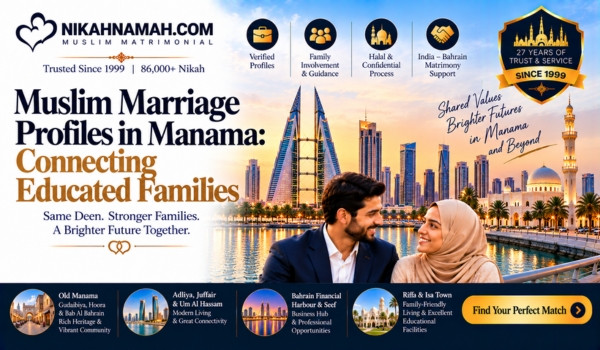
By NikahNamah | India's Most Trusted Muslim Matrimony Platform Since 1999
On a weekday evening in Manama, the story of many Indian Muslim families plays out in a few short scenes. A father locks up a trading office in the old souq near Bab Al Bahrain, where his own father once worked. His daughter, a chartered accountant, is leaving a glass tower in the Bahrain Financial Harbour after a long audit day. His son, an IT engineer, is driving back from Seef. His wife is finishing a call with her sister in Mangalore about a proposal that has just arrived from Hyderabad. By Maghrib they are all home in Hoora or Adliya, and the conversation at dinner turns, as it often does in these homes, to one question: where will we find a family like ours?
"Like ours" does not mean rich, and it does not mean famous. It usually means educated. It means a family where the daughter's degree is as valued as the son's. It means parents who read, who discuss, who expect their children to think, and who also expect them to pray. It means a home where a career and deen live side by side, without either one being treated as a threat to the other.
Bahrain has produced many families like this. The island's relationship with India is older than oil, going back to the pearling era and the dhow trade between Manama, Muharraq and the ports of Gujarat, Kutch, Malabar and the Konkan coast. When oil was discovered in Bahrain in 1932, the first such discovery on the Arab side of the Gulf, a new chapter began. Indian engineers, clerks, doctors, nurses, teachers and traders came, and many stayed for decades. Today the Indian community is widely described as the largest expatriate community in the Kingdom, and its Muslim families include people whose grandparents arrived before independence alongside young professionals who landed last year.
What makes Manama special for matchmaking is the education of these families. Two and sometimes three generations have studied at Indian schools in Isa Town and Manama, gone to university in India, the UK, or Bahrain itself, and returned to work in banking, healthcare, engineering and technology. Their daughters are doctors, pharmacists, auditors, architects and teachers. Their sons are engineers, analysts, bankers and entrepreneurs. When these families look for a rishta, they are looking for another family that shares the same respect for learning and the same love for Islam.
This guide is for Manama-based Muslim professionals, for their parents, and for families in India who are reading a Bahrain-based profile and wondering what life there is really like. At NikahNamah, India's trusted Muslim matrimony platform and marriage bureau since 1999, with offices in Bangalore's Jayanagar 9th Block and Frazer Town, we have guided families across the India-Gulf corridor for decades. With 86,000+ successful Nikah and 96,461+ registered members, we bring verified profiles, personal Relationship Managers and a 100% halal process to this search.
If you have already read our guide for Indian Muslim grooms in Bahrain, this article takes a wider view. It is about educated families on both sides, including Manama-based brides, working women and the parents who are searching for them.
Manama and Bahrain's Indian Muslim Community - Areas, Mosques and Everyday Life
Bahrain is small. The main island can be crossed by car in well under an hour, and most Indian families live within a short drive of central Manama. That compactness shapes community life. People meet the same families at the mosque, at school events, at community association functions and at weddings, which means reputation travels fast and families tend to know a great deal about each other. For matchmaking, that is both a strength and a limitation, and we will come back to it.
Old Manama - Gudaibiya, Hoora, the Souq and Bab Al Bahrain
The older heart of the city, around the Manama Souq and Bab Al Bahrain, is where many Indian trading families first settled. Gold shops, textile stores, spice traders, electronics dealers and small restaurants still line the lanes, and many are run by families from Kerala, Gujarat, Karnataka and Tamil Nadu. Gudaibiya and Hoora, just to the east, are long-established residential areas with a large Indian population, affordable apartments, familiar grocery stores and small neighbourhood mosques within walking distance.
Families from this part of Manama are often deeply rooted. Some have lived in Bahrain for forty or fifty years. Their children may speak Malayalam, Urdu, Kannada or Gujarati at home, Arabic at school and English at work. Their profiles often carry a strong sense of family history and community reputation.
Adliya, Juffair and Um Al Hassam
South of the old city, Adliya is known for its restaurants and cafes, while Juffair has grown rapidly with high-rise apartments. Juffair is also home to the Al Fateh Grand Mosque, one of the largest mosques in the country and a landmark for residents and visitors. Many younger professional couples and newly arrived families rent in Juffair and Um Al Hassam because of the modern buildings and short commute to the city's offices.
Seef, Sanabis and Bahrain Financial Harbour
Seef is Manama's commercial district, with malls, hotels and office towers. The Bahrain Financial Harbour and the Bahrain World Trade Center stand along the northern waterfront, and Bahrain Bay has added new residential and office projects. This is where many of Bahrain's banks, insurance companies, audit firms and consultancies are based. Profiles from this belt are often bankers, chartered accountants, risk and compliance officers, IT professionals and management consultants. Many of them are women.
Muharraq
Across the bridge from Manama, Muharraq is the older capital and one of the most historic parts of the island. Its pearling heritage is recognised through the Pearling Path, a UNESCO World Heritage site. Bahrain International Airport is here, and so is King Hamad University Hospital. Some long-settled Indian business families live and trade in Muharraq, and its older streets have a strong community character.
Riffa, Isa Town and Hamad Town
To the south, Riffa, Isa Town and Hamad Town are larger residential areas with more villas and family-sized housing. Isa Town is especially important for Indian families because it is home to the Indian School Bahrain, one of the oldest Indian-curriculum schools in the Gulf, and several other schools are spread across Isa Town, Riffa and Manama. Families who prioritise education and a quieter home life often choose these areas, and many of the "educated families" we speak with in Bahrain have lived here for years.
Sitra, Budaiya, Saar and Amwaj
Sitra, on the east coast, is linked to Bahrain's oil and industrial economy, with refinery and industrial facilities nearby. Budaiya and Saar in the north-west are greener suburbs with villas, popular with senior professionals and business owners. Amwaj Islands, a man-made development off Muharraq, attracts some higher-income professionals who prefer waterfront apartments.
Mosques, Madrasa and Community Life
Community life for Indian Muslims in Bahrain centres on the mosque, the madrasa and the association. There are mosques in almost every neighbourhood, and Friday prayers bring together families from many Indian states. Weekend madrasa classes teach Quran reading, tajweed and Islamic studies to children. Indian community associations, including state-based cultural groups, professional bodies and religious organisations, hold iftars, Eid gatherings, lectures and family events. The Indian Club, founded more than a century ago, is one of the oldest Indian institutions in the Gulf and a reminder of how long the community has been part of Bahraini life.
For matchmaking, this network matters. A family's standing in the mosque committee, the madrasa or a community association often says as much about their values as any line in a biodata. It is also why families in Bahrain are sometimes cautious about proposals within their own small circle. Nobody wants a declined rishta to become a topic at the next Eid gathering.
Professional Sectors That Shape Manama Marriage Profiles
Bahrain's economy is more diversified than most people in India assume. The main sectors you will see on Manama-based profiles are:
- Banking and Islamic finance. Bahrain has long been a regional banking centre and a major hub for Islamic finance. It hosts AAOIFI, the international body that sets standards for Islamic financial institutions. Many Indian Muslim professionals, including many women, work as bankers, auditors, Shariah compliance officers, risk analysts and accountants.
- Healthcare. Hospitals such as Salmaniya Medical Complex and King Hamad University Hospital, along with private hospitals and clinics, employ Indian doctors, nurses, pharmacists, lab technicians and physiotherapists.
- Education. Indian schools and international schools employ teachers, coordinators and administrators, and some professionals teach at universities and polytechnics.
- Oil, refining and industry. BAPCO and related energy companies, together with industrial units around Sitra, employ engineers, technicians and project managers.
- Aluminium and manufacturing. Alba, one of the world's larger aluminium smelters, and the manufacturing companies around it employ engineers, finance staff and supply-chain professionals.
- IT and telecom. Bahrain has actively promoted fintech and technology, and Indian software engineers, cloud specialists and telecom professionals are common.
- Trade, retail and business. Many families run trading businesses, restaurants, supermarkets, jewellery shops and service companies, some for more than one generation.
How Bahrain Differs from the UAE, Saudi Arabia, Qatar, Kuwait and Oman
Families in India sometimes treat the whole Gulf as one place. It is not, and the differences matter for marriage.
Bahrain is the smallest of the Gulf states by area and one of the most socially open. Women drive, work in almost every sector and are highly visible in professional life. The workweek usually runs Sunday to Thursday, with the weekend on Friday and Saturday. The King Fahd Causeway, roughly 25 kilometres long, connects Bahrain to Saudi Arabia's Eastern Province, so some families live in Bahrain while one member works in Dammam or Al Khobar, or the other way round. Bahrain's population also includes both Sunni and Shia Muslims, which gives the country a mixed religious landscape that families should understand when discussing maslak and community.
Compared with Dubai and Abu Dhabi, Bahrain is smaller, quieter and in some ways more settled, with many long-staying Indian families rather than a constant flow of new arrivals. Compared with Saudi Arabia, social life is more relaxed. Compared with Kuwait and Qatar, the Indian Muslim community has an older, multi-generational layer that shows up clearly in its educated families. And like Oman, Bahrain feels calm and family-centred, but with a stronger corporate and financial culture in Manama.
Bahrain is also 2.5 hours behind India. When it is 9 PM in Manama, it is 11:30 PM in Bangalore or Hyderabad, which affects when families can speak on video calls. We will return to that practical point later.
What "Connecting Educated Families" Means in the Manama Context
"Educated family" is one of the most common phrases in Indian Muslim matrimony, and one of the most misunderstood. In Manama it has a specific meaning, and it is worth spelling out, because two families can both call themselves educated and still expect very different things.
1. Education Across Generations, Not Just Degrees
Many Bahrain-based Indian Muslim families have been educated for two or three generations. The grandfather may have been a clerk or engineer with an oil company, the father an accountant or doctor, and the children now hold professional degrees from India, the UK or Bahrain. When these families say "educated," they usually mean a household where learning is normal, where parents discuss news and ideas at dinner, and where a child's education is planned from an early age. They are often looking for a family with a similar history, not simply a young person with a similar degree.
2. Daughters' Education and Careers Are Taken Seriously
This is perhaps the single most important point for families in India to understand. In many Manama families, the daughter's education has received exactly the same investment as the son's. She may be a doctor at a Manama hospital, an auditor with a Big Four firm, a pharmacist, an architect, a banker or a teacher. Her parents are proud of that, and they want a rishta from a family that will be proud of it too.
That does not always mean she insists on working after marriage. Some women plan to continue full time, some plan to pause when children arrive, and some want to work part time or from home. What matters is that the conversation is honest and respectful, and that her future in-laws do not treat her qualifications as something to be quietly put away after the Nikah.
3. Deen and Education Together
Educated families in Manama generally do not see a conflict between a professional career and religious practice. Many children have studied Quran and Islamic studies at weekend madrasa alongside their school studies, and some parents are more knowledgeable about Islam than their own parents were. When they look for a match, they want a family that prays, observes Ramadan and brings up children with adab, and that also values learning and professional growth. A proposal that is strong on only one side of this balance often does not move forward.
4. Similar Outlook on Family Life
Educated families in Bahrain often share a certain outlook: smaller families, careful financial planning, children's schooling as a top priority, and a partnership between husband and wife in running the home. They tend to prefer simple Nikah ceremonies and reasonable mehr, and many are uncomfortable with dowry-style demands or show-heavy weddings. These attitudes are a large part of what "educated" means to them, and they are as important as degrees.
5. Language, Culture and Community
Families may be Malayali, Kannadiga, Hyderabadi, Tamil, Gujarati, Bohra, Konkani or from North India, and they often want a match that shares their language and food as well as their outlook. At the same time, educated families in Bahrain are frequently more open to matches across state or language lines than their relatives in India, especially when education, practice and family values align. We always ask both families how flexible they genuinely are, rather than assuming.
6. Maslak and the Sunni-Shia Landscape
Bahrain has both Sunni and Shia Muslim communities, and Indian Muslim families in Bahrain also come from a range of backgrounds, including Sunni families of different schools and Shia families including Bohra, Khoja and Ithna Ashari communities. Most families want a match within their own tradition, and a few are more flexible. The respectful approach is to state this clearly in the profile, discuss it early, and never leave it to be discovered after families have already become emotionally involved.
Three Search Patterns on the India-Manama Corridor
In our experience, most Manama-related searches fall into one of three patterns:
- A Manama-based family seeking a match in India. Often the parents are long settled in Bahrain, and they are looking for a well-educated groom or bride in Bangalore, Hyderabad, Mangalore, Kerala, Chennai, Mumbai or Lucknow. The couple may live in Bahrain after marriage, or they may plan to return to India in a few years.
- An Indian family seeking a Bahrain-based match. Families in India who want their daughter or son to settle in a stable, Muslim-majority country close to home often consider Bahrain favourably, especially if the Bahrain-based family is well established.
- A match within the Gulf. Some Manama families look for matches in Saudi Arabia's Eastern Province, the UAE, Qatar, Kuwait or Oman, where the family background and outlook feel familiar and travel is easy.
Each pattern raises different practical questions, which is why the next section matters.
How to Read Manama Profiles: Gaps, Family Visas and Practical Realities
A Bahrain-based profile can look very similar to an India-based one on paper. The same fields appear: education, job title, salary, city, family background. But a few things need a closer reading, especially when one side is in India and the other in Bahrain.
Important: The following is general information only and is not legal or immigration advice. Visa and residence rules change. Please verify current requirements directly with the official authorities listed below, or through the employer's PRO or HR department, before making any decision.
Official Sources Families Should Check
- Nationality, Passports and Residence Affairs (NPRA), Kingdom of Bahrain: www.npra.gov.bh - the authority for residence permits and family visas. The site may not load from every country; if it does not, use the government portal below.
- Bahrain National Portal: www.bahrain.bh - the official government portal with eServices and information on residence and family matters.
- Labour Market Regulatory Authority (LMRA): www.lmra.gov.bh - work permits and related employment information.
- Embassy of India, Bahrain: www.eoibahrain.gov.in - consular services for Indian nationals, including attestation services and miscellaneous consular services, including solemnization of marriage under the Foreign Marriage Act, 1969.
- Ministry of External Affairs, India - Apostille: www.mea.gov.in/apostille.htm - for apostille of Indian documents such as marriage and educational certificates.
The General Family Visa Picture (Verify Officially)
In broad terms, a Bahrain-based expatriate who wants to bring a spouse to Bahrain usually needs a valid residence permit, employment or business status that allows family sponsorship, and a salary at or above the minimum set for family sponsorship. The sponsor typically also needs suitable accommodation and a properly attested marriage certificate.
Salary thresholds for family sponsorship have been reported at different levels over the years and can differ by category. We deliberately do not quote a single figure here, because a number that is out of date can mislead a family. Please confirm the current requirement with the NPRA, the Bahrain National Portal, or the employer's PRO before relying on it.
For a marriage solemnized in India, families should expect the Nikahnama and the registered marriage certificate to go through attestation or apostille in India and then any further steps required in Bahrain. For a marriage in Bahrain, the Embassy of India's consular pages explain the options available to Indian nationals, including solemnization under the Foreign Marriage Act, 1969, with its own notice period, age and eligibility conditions. The process, documents and timelines should always be checked on the official pages.
A few practical points families often discuss:
- Women who sponsor. In some cases, working women may be able to sponsor a husband or children, subject to conditions. If a Manama-based bride is the primary earner or expects to sponsor, the couple should check eligibility early with the NPRA rather than assume.
- Working after arrival. A spouse who arrives on a family visa and wants to work usually needs a separate work permit process. Families should check current LMRA rules instead of assuming the spouse can start work immediately.
- Causeway families. Where one spouse works in Saudi Arabia's Eastern Province and the family lives in Bahrain, or the reverse, both countries' residence rules apply. This arrangement can work well, but it needs careful planning.
Gaps Families Often Miss When Reading Manama Profiles
- Visa status versus job title. A profile may say "Senior Accountant, Manama," but what matters for family life is whether the job allows family sponsorship, how long the contract runs and how stable the employer is. It is fine to ask politely.
- Long-settled versus newly arrived. A family that has lived in Bahrain for thirty years has a different life from a young professional who arrived two years ago. Both can be excellent matches, but expectations about the future differ.
- Future plans. Does the couple plan to stay in Bahrain, move to another Gulf country, go to Canada or the UK, or return to India? Many Manama families have a clear plan, and it should be discussed early.
- Education verification. Degrees from Indian, British, Bahraini or other universities should be verifiable. Educated families usually welcome this rather than resent it.
- The working-woman question. If the bride is a working professional in Manama, both families should discuss openly whether she will continue working, where, and how household responsibilities will be shared.
- Children's schooling. For families planning to stay in Bahrain, the choice and cost of schools is a real part of the conversation, and educated families take it seriously.
- Time difference. Bahrain is 2.5 hours behind India. Video calls that suit a Manama family after work can be late at night in India, so plan them with care for elders on both sides.
- Maslak and community. Given Bahrain's Sunni-Shia landscape and the diversity of Indian Muslim communities there, a clear statement of maslak and community avoids confusion later.
How This Should Appear in a Manama-Based Profile
A strong Manama-based profile usually includes:
- Current city and area in Bahrain (for example, Juffair, Riffa or Isa Town), and how long the family has lived there.
- Education, including institution and year, for the candidate and ideally the parents and siblings.
- Job title, employer type and sector, and whether the role supports family sponsorship.
- Religious practice described simply and honestly: salah, hijab or beard where relevant, Quran reading and maslak.
- The couple's intended place of residence after marriage and any long-term plan.
- For women professionals, a clear note on career plans after marriage.
- Native place and community in India, and connections with relatives there.
At NikahNamah, our Relationship Managers help families write profiles that include these details warmly and clearly, so the right families recognise each other quickly.
Success Stories
The stories below reflect the kinds of journeys we see on the India-Manama corridor. Names and some details have been changed to protect the privacy of the families.
Story 1: The Seef Auditor and the Bangalore Family Who Valued Her Career
Ayesha grew up in Isa Town, studied at an Indian school in Bahrain and qualified as a chartered accountant in India before returning to work with an audit firm in Seef. She was twenty-seven, prayed regularly and wore hijab, and she was clear about one thing: she wanted to keep working after marriage, at least until children arrived. Two earlier proposals had faded once the other families understood this.
Her mother registered with NikahNamah and told our Relationship Manager exactly that. Rather than sending a long list of profiles, the RM looked for families where women's education was already part of the family story. One such family was in Bangalore's Frazer Town. The father was a retired professor, the mother a school principal, and their son, Faizan, was a software architect with a multinational company who had recently accepted a role that would allow him to relocate to Bahrain.
The first call between the mothers lasted almost two hours. They talked about their children, but also about the books they read, the madrasa their families supported and their shared dislike of expensive weddings. Faizan and Ayesha then spoke with families present, discussed careers, prayer and where they would live, and found themselves agreeing more often than not. Their Nikah took place in Bangalore with a simple ceremony, followed by a small gathering in Manama. Ayesha still works at her firm in Seef, and Faizan's mother likes to tell people that her daughter-in-law "checks the accounts of half of Manama."
Story 2: The Manama Doctor and the Hyderabad Family Seeking Deen and Degrees
Dr. Imran was a Hyderabadi physician at a Manama hospital. His parents had moved to Bahrain in the 1990s, and he had grown up between Hoora and Riffa. He wanted a wife who was educated and practising, and his parents wanted a family from Hyderabad who shared their Urdu-speaking culture and their commitment to religious learning.
The difficulty was that most proposals they received were either strong on education or strong on religious practice, but rarely both. Our RM suggested a more focused search and spoke in detail with a family in Tolichowki, Hyderabad, whose daughter, Sana, was a dentist who had also completed a two-year Islamic studies course. Her father was an engineer and her mother had taught Arabic for years.
The RM arranged an initial conversation between the fathers, then between both families. The questions were thoughtful and direct: where the couple would live, whether Sana could practise dentistry in Bahrain and what licensing it would involve, and how the families would share Eid and holidays across the two countries. With help from the families, the couple researched the licensing and visa steps on the official Bahrain pages before finalising. The Nikah took place in Hyderabad, and Sana moved to Bahrain once the family visa was completed. She is now preparing for her professional licensing while teaching Quran to children at a local madrasa on weekends.
Story 3: The Muharraq Business Family and the Mangalore Engineer
The Rahman family has run a trading business near the Manama Souq for three generations, and they live in Muharraq. Their daughter, Mariyam, studied architecture and joined the family business to modernise its design and retail side. The family were well known in the community, which made them hesitant to look within Bahrain, where every proposal and every decline would be noticed.
They approached NikahNamah for discretion. The RM kept the search private and shared Mariyam's profile only with a small number of verified families, with the parents' approval at every step. A family from Mangalore, with roots in the Beary community and relatives in Bahrain, came forward for their son, Adil, a civil engineer working in Saudi Arabia's Eastern Province.
What made the match work was the geography. Adil could cross the King Fahd Causeway to visit Mariyam's family on weekends, and both families were comfortable with a plan in which the couple would live in Bahrain while Adil commuted until he found work there. Both families checked the residence and work permit steps on the official sites before the wedding. Their Nikah was held in Mangalore, with a walima in Manama attended by many of the same families who had once been the reason for caution.
Story 4: The Riffa Family, the Kerala Teacher and a Second Marriage Handled with Dignity
Sameer was a finance manager in Manama who had been divorced for three years, with no children. His family, long settled in Riffa, were worried that his previous marriage would make the search difficult. They wanted an educated, mature bride and a family that would judge Sameer on his character rather than his past.
The RM encouraged them to be completely open in the profile, stating the divorce simply and without blame. This honesty attracted a family in Kozhikode whose daughter, Nasreen, a schoolteacher in her early thirties, had herself been widowed young. Both families appreciated the clarity. After several calls, including one in which the elders spoke about their own experiences of loss and patience, the families agreed to proceed.
The Nikah was held quietly in Kozhikode. Nasreen now teaches at an Indian school in Bahrain, and Sameer's mother says the best part of the process was that "nobody had to hide anything."
Testimonials
"We have lived in Bahrain for more than twenty-five years, and finding a family that respected our daughter's career and our deen was not easy. Our Relationship Manager understood both. The process was respectful, private and honest from the first call." - Shahida, mother of a bride, Isa Town
"I work long hours in Seef, and the time difference with India made everything harder. NikahNamah scheduled calls that suited both families and handled the follow-up. We are grateful to Allah for a good match." - Tariq, groom, Manama
"As a family in Hyderabad, we had many questions about life in Bahrain, visas and work for our daughter. The RM did not pretend to be a lawyer. She told us which official websites to check and helped us ask the right questions." - Mohammed Ali, father of a bride, Hyderabad
"Our family is well known in the Muharraq community, so discretion mattered. NikahNamah shared our profile only with families we approved. That gave us peace of mind." - Fathima, sister of a bride, Muharraq
"My parents and I wanted someone educated who also takes salah seriously. NikahNamah listened and did not send random profiles. Alhamdulillah, our Nikah happened within a year." - Nabeel, groom, Riffa
How NikahNamah Serves Manama-Based Families
A Personal Relationship Manager Who Understands Educated Families
When a Manama-based family registers with NikahNamah, they are assigned a personal Relationship Manager. The RM begins with a detailed conversation, usually with the parents and often with the candidate too, about education, profession, religious practice, maslak, native place, language, career plans after marriage and where the couple hopes to live. For educated families, we also ask about the education and professions of parents and siblings, and about the family's outlook on women's work, because these are often the real deciding factors.
The RM then shortlists a small number of verified profiles that genuinely fit, explains why each one was suggested, and coordinates introductions only with the family's approval.
Our process usually follows these steps:
- Registration and consultation. The family registers online or through our Bangalore offices, and the RM holds a detailed first conversation.
- Profile building. The RM helps prepare a clear, honest profile that includes the Bahrain-specific details families need.
- Verification. Profiles are manually verified before introductions.
- Curated shortlists. The RM shares a limited number of relevant matches rather than overwhelming the family.
- Family introductions. Calls between families are arranged at times that suit both Bahrain and India.
- Follow-up and guidance. The RM stays involved through the conversations and helps both sides raise sensitive questions respectfully.
- Nikah planning support. Families are guided on the general sequence of practical steps, with a clear reminder to confirm legal and visa requirements with official authorities.
Local Knowledge That Generic Apps Do Not Have
Our Relationship Managers understand the practical realities of Manama and Bahrain, including:
- The difference between Manama's older areas like Gudaibiya and Hoora and newer areas like Juffair, Seef and Amwaj.
- Why Isa Town and Riffa matter to families who prioritise children's schooling.
- The sectors that dominate Bahrain-based profiles, from banking and Islamic finance to healthcare, refining, aluminium and IT.
- The King Fahd Causeway and how it shapes families with one foot in Bahrain and the other in Saudi Arabia's Eastern Province.
- The 2.5-hour time difference, the Friday-Saturday weekend, and how to schedule calls with elders in India.
- The need for discretion in Bahrain's close-knit Indian Muslim community.
- The official sources families should use for visa, residence and marriage documentation.
Verified Profiles and a 100% Halal Process
Every profile is reviewed and verified. Communication is family-focused, and our process is 100% halal from the first enquiry to the Nikah. There is no dating-app culture, no casual chatting encouraged outside family guidance, and no pressure. We work with serious families who intend marriage.
Register and Begin
Manama-based families and families in India considering a Bahrain proposal can register at www.nikahnamah.com, call or WhatsApp +91 98451 30331 or +91 90360 22522, or email support@nikahnamah.com or info.nikahnamah@gmail.com. Our office hours are Monday to Sunday, 10:00 AM - 8:00 PM IST (Friday off), which is 7:30 AM - 5:30 PM in Bahrain.
Frequently Asked Questions
1. Does NikahNamah have Muslim marriage profiles from Manama and Bahrain? Yes. NikahNamah works with Indian Muslim families living in Manama, Muharraq, Riffa, Isa Town, Hamad Town and other parts of Bahrain, as well as with families in India who are open to a Bahrain-based match. Our Relationship Managers can guide you through verified profiles that fit your preferences.
2. What does "educated family" mean in a Manama profile? Usually it means more than a degree. It refers to a family where education runs across generations, where daughters' education and careers are valued, and where learning and religious practice go together. We encourage families to describe their educational background and outlook clearly in the profile.
3. My daughter works in Manama. Will families in India accept a working bride? Many will. A growing number of educated families in India actively prefer a professional daughter-in-law. The key is to state her career plans honestly and to look for families whose own background shows respect for women's education. Our RMs focus on exactly that fit.
4. Can a Manama-based professional sponsor a spouse from India? In general, expatriates in Bahrain who meet the requirements, including a minimum salary set for family sponsorship, a valid residence permit and attested marriage documents, may sponsor a spouse. Requirements change and can differ by category, so please verify the current rules with the NPRA (www.npra.gov.bh) or the Bahrain National Portal (www.bahrain.bh). This is general information, not legal advice.
5. Where should we get our marriage certificate attested? Indian documents are generally apostilled or attested through the Ministry of External Affairs (mea.gov.in/apostille.htm). The Embassy of India in Bahrain also lists its attestation services. Check the exact steps required in Bahrain with the NPRA or your employer's PRO.
6. Can we have the Nikah in Bahrain instead of India? Some families do. Options for Indian nationals are explained on the Embassy of India's consular services page, including solemnization under the Foreign Marriage Act, 1969, with its own conditions and notice period. Families should confirm the process, documents and religious requirements before planning.
7. How do you handle the time difference between Bahrain and India? Bahrain is 2.5 hours behind India. Our RMs schedule family calls at times that suit both sides, often in the Bahrain late afternoon or on the Friday-Saturday weekend, so elders in India are not kept up too late.
8. We are well known in the Bahrain community. Can our search be kept private? Yes. Discretion is one of the main reasons Bahrain families come to us. Your profile can be shared only with families you approve, and your RM will not circulate your details widely.
9. Do you consider maslak and community preferences? Yes. Whether you are Sunni or Shia, and whatever your community, school of thought or language, we record your preferences carefully and match accordingly. We also help families discuss flexibility honestly where it exists.
10. How do we register? Register at www.nikahnamah.com, or call or WhatsApp +91 98451 30331 or +91 90360 22522. You can also email support@nikahnamah.com or info.nikahnamah@gmail.com. A Relationship Manager will contact you to begin.
Closing Reflection - When Learning and Faith Meet in One Home
The families of Manama have spent decades building something worth passing on. Parents crossed the sea, worked hard and invested in their children's education, while holding on to salah, Ramadan, Quran classes and the values they brought from India. Their children grew up in a small, open, Muslim-majority country where daughters became doctors and auditors, sons became engineers and bankers, and both were taught that knowledge is a trust from Allah.
When such a family looks for a rishta, they are not looking for a CV. They are looking for another home where learning and faith meet at the same dinner table. That is what connecting educated families really means, and it is the work we have done at NikahNamah since 1999.
If you are a Manama-based Muslim professional or parent, or a family in India reading a Bahrain proposal, we invite you to register with NikahNamah and speak to a Relationship Manager who understands both sides of this corridor. With 86,000+ successful Nikah and 96,461+ registered members, our aim remains simple: verified families, honest conversations and a Nikah completed with dignity.
May Allah bless every sincere search with ease, join hearts that seek His pleasure, and fill the homes of Muslim families in Bahrain and India with knowledge, sakina and barakah. Ameen.
Register today: https://www.nikahnamah.com/ Call / WhatsApp: +91 98451 30331 | +91 90360 22522 Email: support@nikahnamah.com | info.nikahnamah@gmail.com
Also Read
- Indian Muslim Grooms in Bahrain: Finding the Right Bride for Nikah
- Muslim Professionals in Saudi Arabia: Connecting with Compatible Families
- Indian Muslim Grooms in Doha: Finding the Right Marriage Proposal
- Indian Muslim Grooms in Muscat: Finding an Educated Marriage Partner
- Indian Muslim Grooms in Dubai: Finding Educated Brides for Nikah
- Muslim Marriage Proposals in Melbourne: Connecting Educated Families in India and Australia
- Muslim Marriage Proposals in Paris: Connecting Educated Families for Nikah
- Muslim Marriage Profiles in California: Educated, Career-Focused Matches
- Muslim Matrimony in Toronto: Connecting Professional Families for Marriage
- Muslim Matrimony for Professionals in India and Abroad
- Principles of a Happy Marriage According to Islamic Teachings
- Why Compatibility in Nikah Matters
- Verified Matrimony Profiles for a Safe Nikah Search
- Cross-Border Muslim Marriage Matchmaking
About NikahNamah
NikahNamah is India's trusted Muslim matrimony platform and marriage bureau since 1999. We combine offline marriage-bureau care in Bangalore with online reach across India and the global Muslim diaspora, including Bahrain, the UAE, Saudi Arabia, Qatar, Kuwait, Oman, the United Kingdom, the United States, Canada, Germany and Australia.
We offer personalized Relationship Manager matchmaking, manually verified profiles, advanced filters for faith and community preferences, and a 100% halal process from registration to Nikah. Whether you are a Manama-based Muslim professional or a family in India considering a Bahrain proposal, we are here to guide you with warmth, clarity and respect.
With 86,000+ successful Nikah and 96,461+ registered members (figures as published on www.nikahnamah.com), our work remains personal, transparent and marriage-focused.
Office and Contact
Main Branch: Jayanagar 9th Block, Bengaluru - 560069 Other Branch: Frazer Town, Bengaluru - 560005
Phone / WhatsApp: +91 98451 30331 | +91 90360 22522 Email: support@nikahnamah.com | info.nikahnamah@gmail.com Website: www.nikahnamah.com
Office Hours: Monday to Sunday, 10:00 AM - 8:00 PM IST (Friday Off) Service Area: All India | UAE | Saudi Arabia | Qatar | Kuwait | Bahrain | Oman | UK | USA | Canada | Germany | Australia

💬 Comments