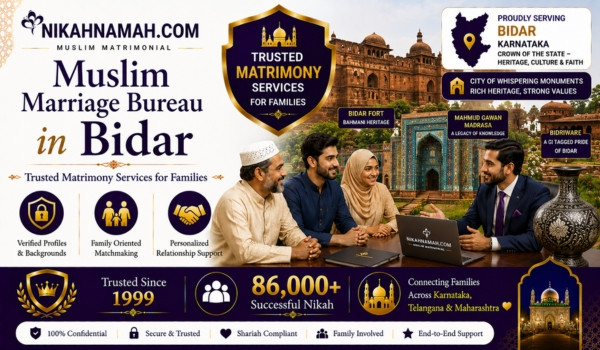
By NikahNamah | India's Most Trusted Muslim Matrimony Platform Since 1999
Bidar carries more Islamic architectural and historical weight per square kilometre than almost anywhere else in Karnataka. Thirty of the sixty-one monuments listed by Karnataka's Department of Archaeology in the city and its surroundings are tombs - an extraordinary concentration of Deccani Sultanate funerary architecture that has earned Bidar the poetic title "City of Whispering Monuments." The massive Bidar Fort, built by Ahmad Shah Wali Bahmani in the 15th century with its triple moat and red laterite walls, still dominates the city's layout after six centuries. The ruins of the Mahmud Gawan Madrasa - one of the great Islamic educational institutions of medieval India, built in 1472-81 by the Bahmani prime minister - stand as a reminder of a time when this city was a centre of scholarship and culture across the Deccan. And beneath the city's streets runs the Bidar Karez - a 15th-century underground aqueduct system of 3 kilometres and 21 air vents, believed to be among the earliest such systems in India, engineered during the Bahmani period to bring drinking water to a city whose laterite soil made conventional wells impossible.
This is also the city that gave the world Bidriware - a uniquely Bidari metal inlay craft, dating to the Bahmani period, in which silver wire is worked into a zinc-copper alloy base darkened with the specific soil of Bidar itself, producing objects of a distinctive, globally recognised beauty that has earned the craft its own Geographical Indication tag. No other city in the world produces Bidriware. It is, genuinely and specifically, Bidar's own.
For Bidar's Muslim community - 34.53% of the city's population, approximately 110,000 people in the city by 2026 estimates, engaged in Bidriware workshops, carpet weaving, agricultural trade, commerce, and a growing professional class - all of this heritage is not background but living identity. A trusted marriage bureau for this community is one that understands this identity in full - its specific Bahmani second-capital heritage, its cross-border matrimony geography stretching into Telangana and Maharashtra, its Bidriware artisan tradition, and the particular character of a city that sits, geographically and culturally, at the northernmost point of Karnataka and the intersection of three states' Muslim worlds.
Bidar's Muslim Community - Second Capital, Enduring Identity
The Bahmani Second Capital - Distinct From Kalaburagi's First-Capital Story
Bidar's relationship with the Bahmani Sultanate is different from Kalaburagi's - and this difference matters for understanding the two cities' distinct Muslim identities. Where Kalaburagi was the founding capital, established in 1347 at the Sultanate's creation, Bidar became the second and more developed capital in 1425 when Ahmad Shah Wali Bahmani shifted the seat of power northward, finding Bidar's climate superior and its land more fertile than Kalaburagi's. The Bahmani Sultanate at its most architecturally ambitious - the great fort complex, the palaces, the Rangin Mahal with its coloured tile decorations, the Mahmud Gawan Madrasa, the royal tombs east of the city - belongs to Bidar, not to Kalaburagi.
When the Bahmani Sultanate fragmented after 1518 into the five Deccan Sultanates, Bidar became the centre of its own successor dynasty: the Barid Shahi sultanate, founded (in one of history's more remarkable details) by a man of Georgian slave origins, whose dynasty ruled from Bidar until the Bijapur Sultanate absorbed the city in 1619. This was followed by Aurangzeb's Mughal presence and then the Nizam of Hyderabad's rule until 1948. The result is a city whose Muslim heritage carries the imprint of four distinct dynastic periods - Bahmani, Barid Shahi, Mughal, and Hyderabadi - each leaving its mark on the architecture, the community culture, and the social world that today's Muslim families in Bidar inhabit.
Bidriware - A GI-Tagged Craft That Belongs to Bidar Alone
No account of Bidar's Muslim community is complete without Bidriware, and no honest matrimony guide for this city can treat it as a footnote.
Bidriware originated in Bidar during the Bahmani Sultanate's period - a craft developed by Muslim artisans combining Persian metalworking traditions with Deccan aesthetic sensibilities, producing silver-inlaid work of a distinctive beauty that became both a court luxury and a community livelihood. The craft's most specific, irreplaceable detail: the alloy base - a mixture of zinc and copper - is darkened using a paste made from the specific soil of Bidar fort, soil whose unique mineral composition produces the deep, permanent black that gives Bidriware its characteristic look. No other soil in the world does this. Bidriware cannot be authentically produced anywhere but Bidar.
This craft has been awarded Geographical Indication status - legally protecting the designation "Bidriware" as belonging exclusively to Bidar's production - and has been recognised by UNESCO's cultural heritage programs and India's craft promotion institutions. Bidriware workshops, concentrated in the areas around the old city and the fort, employ Muslim artisan families who have maintained this tradition across generations.
For matrimony purposes, the Bidriware artisan community represents a specific, distinct economic and cultural identity within Bidar's Muslim population - one that combines deep craft heritage, GI-tagged product recognition, and the particular social standing of a community whose livelihood is also a living piece of cultural history.
The "Crown of the State" Geography - Three Borders, Three Muslim Worlds
Bidar's geographic position is genuinely unusual: it is Karnataka's northernmost district, officially called the "Crown of the State," bounded by Telangana to the east, Maharashtra to the north and west, and Kalaburagi district to the south. This three-border position creates a cross-state matrimony geography that is unique among all the North Karnataka cities in this series.
For Bidar's Muslim families, the natural matrimony corridor does not simply run south toward Kalaburagi, Raichur, and Hyderabad - it extends west into Maharashtra's Latur, Osmanabad (Dharashiv), and Nanded districts (also former Hyderabad State territory, sharing the Deccani Muslim cultural heritage), north into Maharashtra's Nanded district with its own Muslim communities, and east into Telangana. A marriage bureau that understands this geography and works all three directions actively provides a fundamentally different service from one that treats Bidar as just another North Karnataka district with a south-facing search horizon.
The Multi-Faith Character - Gurudwara Nanak Jhira and Islamic Heritage Side by Side
Bidar is genuinely remarkable for its coexistence of major Islamic heritage with one of India's most significant Sikh pilgrimage sites - the Gurudwara Nanak Jhira Sahib, where Guru Nanak Dev Ji is believed to have visited during a famine, is considered one of the holiest sites for Sikh devotees in India. This multi-faith character is not incidental to Bidar's identity but is woven into its civic self-understanding - a city where Islamic architectural heritage of the highest order exists alongside a Sikh pilgrimage site of national significance, in the geographical shadow of Maharashtra's Sufi and Deccani traditions. For Muslim families in Bidar, daily life in a genuinely multi-faith, multi-cultural city is simply the norm.
The Indian Air Force Connection
India's second-largest Indian Air Force training centre is located in Bidar - a significant military presence that brings professional, educated personnel from across India to the city and its surroundings, contributing to Bidar's relatively high urban literacy rate of 85.90% and adding a professional, nationally connected dimension to the city's population and social world.
What Trusted Matrimony Services Mean for Bidar Families
The Bidriware Artisan Community - Heritage Craft as Living Identity
For families connected to Bidar's Bidriware workshops, matrimony carries a specific, dual dimension that most generic matchmaking services miss entirely: the craft itself is not merely an occupation but a living cultural inheritance, and the continuity of that inheritance through the family is a genuine part of what matrimony means for these families. A daughter-in-law entering a Bidriware artisan household enters a world that is simultaneously a craft workshop, a cultural heritage site, and a family business - and the right match for such a family is one who understands and respects all three dimensions rather than seeing only the economic dimension.
A trusted bureau serving Bidar's Bidriware artisan families asks specifically about this dimension and seeks matches from families who bring either direct craft tradition experience, genuine cultural respect for artisan heritage, or the kind of open, curious orientation toward a living craft that would make integration into this specific world natural rather than strained.
The Cross-Border Geography Needs Active, Specific Working
For Bidar families whose natural matrimony horizon extends into Maharashtra and Telangana, a marriage bureau's value is precisely its ability to work across these state boundaries with genuine knowledge of the Muslim communities on both sides. Maharashtra's Latur and Nanded districts share Bidar's Deccani Sultanate cultural heritage - they too were under the Nizam of Hyderabad - and their Muslim communities carry a familiar Urdu and Dakhini cultural register. Hyderabad's Muslim professional class is Bidar's most obvious professional-search horizon to the east. A trusted bureau for Bidar works all of these directions actively rather than treating state boundaries as search horizons.
Honest About the Kalaburagi Direction As Well
For Bidar families whose search stays within Karnataka, Kalaburagi is the most natural and culturally resonant direction - sharing the Bahmani heritage, the Dakhini Urdu cultural identity, and the broader North Karnataka Muslim world. This Bidar-Kalaburagi corridor, 70 kilometres of shared history, is the most important Karnataka-internal matrimony geography for Bidar families and deserves active, specific attention from any bureau serving this community.
The Professional Class in a City With Substantial Institutional Infrastructure
With an urban literacy rate of 85.90%, several colleges affiliated with Gulbarga University, and the IAF training centre's professional community, Bidar has more robust professional-class infrastructure than several of the smaller North Karnataka cities in this series. The Muslim professional community - doctors, engineers, lawyers, teachers, government employees - is real and growing, and Bidar's professional matrimony search can productively include both within-city and Kalaburagi/Hyderabad-horizon approaches without necessarily jumping to the very widest search immediately.
Real Stories: Bidar Muslim Families Finding the Right Match Through NikahNamah
Story 1: The Bidriware Artisan Family - When Craft Heritage Was Honoured Specifically
The Siddiqui family had been producing Bidriware in Bidar for three generations - a workshop near the old fort area whose pieces had been featured in Indian craft exhibitions and whose work was known within the GI-protected Bidriware artisan community. Their son Tariq, 27, had grown up within the workshop alongside a commerce degree, and his family was deeply proud of their place in this living heritage tradition.
Previous matrimony conversations had, without exception, treated the Bidriware workshop as simply "a small manufacturing business" - missing the cultural heritage, the GI protection, the community standing, and the specific meaning of carrying forward a craft tradition that belongs uniquely to Bidar. Families had evaluated Tariq's background as if it were a generic artisan-class household rather than a distinguished participant in one of India's most recognised GI-tagged heritage crafts.
NikahNamah's Relationship Manager engaged with this directly from the first conversation - presenting the Siddiqui family's Bidriware background with the full, specific pride it deserved: the craft's Bahmani-era origins, its GI status, the role of Bidar's own soil in the production process, and the cultural significance of a family maintaining this tradition across generations. She specifically sought families who genuinely understood or deeply appreciated living craft heritage - whether from their own artisan background or from a cultural orientation that would make entry into this specific world feel like a privilege rather than an unfamiliar adjustment.
"Every previous matchmaker described us as 'artisan family' as if that was something to navigate around rather than take pride in," Tariq's father said. "NikahNamah's RM described Bidriware specifically - the GI tag, the Bahmani heritage, what it means that our craft uses the soil of Bidar fort itself. She presented our family as the cultural custodians we are. That's a completely different conversation."
The match was a 25-year-old from a Kalaburagi family - her own grandfather had been a Bidriware collector whose appreciation for the craft was genuine and deep - who arrived at the introduction with a specific, informed respect for what the Siddiqui family represented that made the relationship immediately grounded in mutual understanding.
Story 2: The Maharashtra-Connected Family - When the Cross-Border Search Was Worked Actively
The Ansari family in Bidar had commercial connections extending into Maharashtra's Latur district - a grain trading business that moved jowar and wheat across the Bidar-Latur border. Their daughter Asma, 24, had completed a BSc and her family's matrimony search had a specific, articulated preference: a match from within the Deccani Muslim cultural world that Bidar and Latur shared, rather than from the more distant cultural horizons of South Karnataka or even Hyderabad.
NikahNamah's Relationship Manager worked the Maharashtra corridor specifically and actively - not as an unusual request requiring special justification, but as the natural, obvious matrimony geography for a Bidar family with commercial and cultural connections across the state boundary. She engaged with the specific Muslim communities in Latur and Osmanabad districts that shared Bidar's former-Nizam-state Deccani heritage, presenting Asma's family within this cross-border shared world rather than treating the search as if state boundaries marked cultural limits.
"Most matchmakers treated Maharashtra as 'going outside' in a way that made it sound unusual," Asma's mother said. "The RM understood that Latur and Bidar share a world - same Nizam history, same Dakhini Urdu culture, same agricultural trade connections. The state boundary on a map is not a cultural boundary in our community's actual life."
The match was from a Latur Muslim family with agricultural trading roots - the families' commercial networks already overlapping through the grain trade - creating a proposal with immediate, natural practical context alongside personal compatibility.
Story 3: The Professional Family - When the Bidar-Kalaburagi Corridor Worked as Intended
Dr. Amir, 30, was a physician in Bidar city's private hospital sector, from a Bidar Muslim family with roots in the city's commercial life. His family's matrimony search within Bidar's own Muslim community had produced limited results - the pool of similarly medically qualified Muslim women in Bidar itself was small - and his family was uncertain how far to extend the search.
NikahNamah's Relationship Manager pointed clearly toward Kalaburagi first, explaining the specific logic: 70 kilometres, shared Bahmani heritage, shared Dakhini Urdu cultural identity, a larger Muslim professional community, and the natural south-facing corridor that connects Bidar to North Karnataka's most significant Muslim city. She presented Dr. Amir's Bidar background specifically and confidently to Kalaburagi families - the Bahmani second-capital heritage, the "City of Whispering Monuments" identity, Bidriware, the Bidar Fort - as genuine, distinguished assets rather than something requiring explanation.
"We had been uncertain how far to look and in which direction," Dr. Amir's father said. "The RM was clear: Kalaburagi first, because the shared heritage makes it the most natural cultural match, and because Kalaburagi's Muslim professional community is large enough to produce real options. That directional clarity saved us months."
The match was a 27-year-old doctor from a Kalaburagi family whose own family's deep Bahmani-era cultural roots meant Bidar's identity resonated immediately and warmly - the two families sharing a cultural world that the 70 kilometres between their cities had never interrupted.
Testimonials: Bidar Muslim Families on NikahNamah
"Every previous matchmaker described us as 'artisan family' as if it were something to navigate around. NikahNamah's RM described Bidriware specifically - the GI tag, the Bahmani heritage, the Bidar soil - and presented us as the cultural custodians we are. Completely different conversation." - Father of the Groom, Bidriware Artisan Family, Bidar
"Most matchmakers treated Maharashtra as 'going outside.' NikahNamah's RM understood that Latur and Bidar share a world - same Nizam history, same Dakhini Urdu culture. The state boundary isn't a cultural boundary in our community's actual life." - Mother of the Bride, Bidar
"The RM was clear: Kalaburagi first, because the shared heritage makes it the most natural cultural match. That directional clarity saved us months of uncertain searching." - Father of the Doctor, Bidar
"NikahNamah understood Bidar specifically - the Bahmani second capital heritage, Bidriware, the Bidar Karez, the Crown of the State geography, the Maharashtra and Telangana connections. That layered understanding is what trusted matrimony for this city actually requires." - Muslim Family, Bidar
How NikahNamah Provides Trusted Matrimony Services in Bidar
We understand and honour the Bidriware artisan heritage specifically. Not "artisan family" generically, but the GI-tagged, Bahmani-era, Bidar-soil-specific craft heritage that the Bidriware community represents - presented with the pride and specificity it deserves, and matched with families who genuinely appreciate it.
We work all three directions of Bidar's cross-border matrimony geography. South toward Kalaburagi (the most natural Karnataka-internal corridor), east toward Hyderabad's Muslim professional community, and west and north into Maharashtra's Latur, Osmanabad, and Nanded districts - all worked actively rather than treating state boundaries as search limits.
We present Bidar's extraordinary heritage confidently to outside families. The Bahmani second-capital story, the "City of Whispering Monuments," the Bidriware GI craft, the Bidar Karez - specific, distinguished facts that shift the matrimony conversation from unfamiliarity to genuine interest.
We know the Bidar-Kalaburagi corridor as the primary Karnataka-internal direction. Seventy kilometres of shared Bahmani heritage and Dakhini Urdu cultural identity - the most naturally resonant and practically accessible wider search geography within Karnataka for most Bidar families.
We serve Bidar's full community diversity. Bidriware artisan families, carpet weaving households, agricultural trading families, the professional and government service class, and the broader Muslim commercial community - all served with the specific understanding their particular world requires.
For Bidar Families: Practical Guidance on Your Search
Present Bidriware heritage with full confidence and specificity. It is not a generic artisan occupation - it is a GI-tagged, globally recognised, UNESCO-acknowledged craft tradition unique to your city, with Bahmani-era origins and a production process inseparable from Bidar's own soil. Present it as such.
Know your natural search geography and work it deliberately. Kalaburagi southward, Hyderabad eastward, and Latur/Osmanabad northwestward are all natural directions for Bidar families - commit to working multiple corridors simultaneously rather than committing to one at a time.
Use the "Crown of the State" identity as a specific, proud framing. Bidar is Karnataka's northernmost district, at the intersection of three states, carrying one of the deepest Islamic architectural and cultural heritages in all of South India. Present it as the distinguished place it is.
For professional families, look toward Kalaburagi first. The shared Bahmani heritage, shared Dakhini Urdu culture, and 70-kilometre proximity make Kalaburagi the most natural and culturally resonant professional-search direction within Karnataka before extending to Hyderabad or elsewhere.
Discuss the multi-faith civic character of Bidar as a genuine asset. A city that hosts both Bahmani Sultanate monuments of the first order and one of India's holiest Sikh pilgrimage sites - Gurudwara Nanak Jhira Sahib - is a city comfortable with genuine diversity. This is a civic character worth acknowledging and taking pride in.
Frequently Asked Questions: Muslim Matrimony in Bidar
Q: How is Bidar's Muslim heritage different from Kalaburagi's? Bidar was the Bahmani Sultanate's second and more architecturally developed capital (from 1425), while Kalaburagi was the first (from 1347). Bidar's monument density - 30 of 61 listed monuments are tombs - is extraordinary, earning it the title "City of Whispering Monuments." After the Bahmani breakup, Bidar was the capital of the Barid Shahi dynasty, one of the five successor Deccan Sultanates. Bidar's Muslim heritage is thus both deeper architecturally and more multi-layered dynastically than Kalaburagi's, while sharing the same broad Bahmani cultural foundation.
Q: What is Bidriware, and why does it matter for matrimony conversations? Bidriware is a GI-tagged metal inlay craft unique to Bidar, dating from the Bahmani period, in which silver wire is worked into a zinc-copper alloy base darkened with soil specific to Bidar fort. No other place in the world can authentically produce Bidriware. Muslim artisan families who maintain this tradition are cultural custodians of a globally recognised, legally protected heritage craft - a distinction that deserves to be presented with appropriate pride in any matrimony conversation.
Q: Can Bidar families genuinely look into Maharashtra and Telangana for matches, or does the state boundary make this complicated? Genuinely and naturally - Bidar's neighbouring Maharashtra districts of Latur, Osmanabad, and Nanded share the same former-Nizam-state Deccani Muslim cultural heritage and Dakhini Urdu tradition that Bidar does. The state boundary is administrative; the cultural community it bisects is continuous. A trusted marriage bureau working this cross-border geography provides Bidar families access to a significantly larger natural matrimony pool than a Karnataka-only search offers.
Q: What is the Bidar Karez and why does it come up in conversations about Bidar's heritage? The Bidar Karez is a 15th-century underground aqueduct system - 3 kilometres long with 21 air vents - built during the Bahmani period to bring drinking water to the fort city. It is believed to be among the earliest such systems in India. It is a specific, unusual piece of medieval Islamic engineering heritage that adds to Bidar's already extraordinary monument density and is worth knowing as part of the city's specific identity.
Q: Is Bidar's Muslim professional community large enough to find a match within the city? For some professions, yes - Bidar's urban literacy rate of 85.90% and its institutional infrastructure (several Gulbarga University-affiliated colleges, the IAF training centre) support a real professional community. For highly specialised professions (specialist doctors, senior engineers), the Kalaburagi corridor is the most natural and culturally resonant next step before extending to Hyderabad.
The Whispering Monuments' City Deserves Matchmaking That Listens
Bidar is a city that has had much whispered to it over six centuries - by Bahmani kings and Barid Shahi sultans, by Mughal viceroys and Hyderabadi administrators, by Sufi saints and Sikh gurus, by the Muslim artisans who learned to turn the soil of a fort into the blackest background for silver-wire art the world has ever seen. Its Muslim community carries all of this - as living heritage, as daily craft, as architectural pride, as cross-border cultural connection - and deserves a trusted marriage bureau that listens to this specific, layered identity rather than treating Bidar as just another North Karnataka district.
At NikahNamah, we provide exactly this - with the genuine heritage awareness, cross-border geographic knowledge, and Bidriware artisan respect that Bidar's Muslim families genuinely deserve, built on 27 years of matrimony service across India and the NRI diaspora.
Register for free on NikahNamah today. Whether your family's roots are in Bidar's Bidriware workshops, its carpet weaving households, its agricultural trade, its professional class, or anywhere else in this extraordinary "City of Whispering Monuments" - speak with our team. Bidar's heritage is extraordinary. Your matrimony search should honour it.
May Allah bless every Muslim family in Bidar - in the shadow of the Bahmani kings' tombs and the Bidriware artisans' workshops, at the Crown of Karnataka - and write for each of them a Nikah that brings together two people who are genuinely, specifically, and joyfully right for the life they will build in this ancient, beautiful, monument-rich city. Ameen.
Also Read on NikahNamah Blog
- Muslim Marriage Bureau in Kalaburagi (Gulbarga): Premium Matchmaking Services
- Muslim Marriage Bureau in Raichur: Helping Families Find the Right Nikah Match
- Muslim Marriage Bureau in Shahapur: A Trusted Guide for Families
- Muslim Matrimony in Yadgir: Finding the Right Match with Confidence
- Muslim Matrimony in Australia: A Complete Guide for Families
- Explore all Muslim matrimony guides
About NikahNamah
NikahNamah is India's #1 Muslim Matrimony platform, trusted since 1999. With over 86,000 successful Nikah completed and 96,461+ registered members across India, UAE, Saudi Arabia, Qatar, Kuwait, UK, USA, Canada, Australia, Germany, and beyond - we serve Bidar's Muslim families with the Bahmani-heritage-aware, Bidriware-honouring, cross-border-geography-active trusted matrimony services that the Crown of Karnataka's historic Muslim community genuinely deserves.
📍 Main Branch: Jayanagar 9th Block, Bengaluru – 560069 📍 Other Branch: Frazer Town, Bengaluru – 560005 📞 +91 98451 30331 | +91 90360 22522 🌐 www.nikahnamah.com | ✉️ support@nikahnamah.com ⏰ Monday to Sunday, 10:00 AM – 8:00 PM IST (Friday Off)

💬 Comments