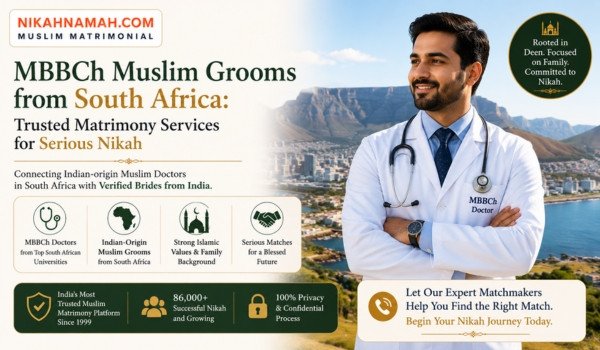
By NikahNamah | India's Most Trusted Muslim Matrimony Platform Since 1999
There is a Muslim doctor in Cape Town.
He completed his MBBCh at a South African university - the MBBCh, the equivalent of the MBBS in the South African medical system, the qualification that took six years to earn and that now earns him the respect of the community he serves. He practices at a hospital in Cape Town or Johannesburg or Durban, serving patients in one of the world's most complex and demanding healthcare environments. His days are long and his cases are real and his commitment to his patients is genuine.
He is also the grandson - or the son, or in some families the great-grandson - of Indian Muslims who came to South Africa generations ago. From Gujarat, perhaps. Or from Uttar Pradesh. Or from Tamil Nadu. The specific origin varies. What does not vary is that the Indian Muslim identity - the language maintained at home, the food, the Islamic practice, the family customs, the deep sense of belonging to a community that has sustained itself across generations in a country far from the subcontinent - is as present and as real in his life as his South African medical career.
And he is looking for a wife.
For many Indian-origin Muslim doctors in South Africa, the matrimony search involves a specific question: should he marry within South Africa's Indian Muslim community, or should he search in India - in the specific region or community that his family's roots trace back to?
This guide is for him - and for his family. It is honest about the specific landscape, specific about the search, and specific about how NikahNamah helps Indian-origin Muslim grooms from South Africa find the right match, whether in India or within South Africa's established Indian Muslim community.
The Indian Muslim Community in South Africa - A Landscape
South Africa's Indian Muslim community is one of the oldest and most established in the world outside the Indian subcontinent. Indians began arriving in South Africa in the 1860s - first as indentured labourers brought to the Natal colony, then as "passenger Indians" who came voluntarily to engage in trade. Among these immigrants were significant numbers of Muslims - from Gujarat, from Uttar Pradesh, from Tamil-speaking communities, from Konkani-speaking communities.
Over 150 years, this community has built something remarkable: a specifically South African Indian Muslim identity that is simultaneously deeply rooted in Islamic practice, deeply connected to Indian cultural heritage, and deeply shaped by the South African experience - the apartheid era, the struggle for dignity and rights, the post-1994 democratic dispensation, and the complex, ongoing project of building an equitable South African society.
Today, South Africa's Indian Muslim community is concentrated in KwaZulu-Natal (particularly Durban and the surrounding areas), in Gauteng (Johannesburg and Pretoria), and in the Western Cape (Cape Town). Durban, historically, has the largest concentration - the city's Muslim community has a rich infrastructure of masjids, Islamic schools, halal businesses, and community organisations that sustains a specific kind of Muslim community life.
The community has also produced, across generations, a significant number of professionals - doctors, lawyers, engineers, academics, business owners - who have built accomplished careers while maintaining their Indian Muslim identity and their Islamic practice.
An MBBCh groom from this community brings all of this with him to the matrimony search: the medical qualification, the professional standing, the deep Indian Muslim family heritage, and the specific South African context that shapes his daily life and his understanding of himself.
The MBBCh Qualification - What It Means and How It Compares
For families in India evaluating a matrimony proposal from a South African Muslim groom, a brief explanation of the MBBCh is useful context.
The MBBCh (Bachelor of Medicine, Bachelor of Surgery, occasionally written as MBChB) is the primary medical degree awarded by South African universities - the University of Cape Town, the University of the Witwatersrand, the University of KwaZulu-Natal, the University of Pretoria, and others. It is the South African equivalent of the MBBS in India and the MB ChB in the UK.
Like the MBBS, the MBBCh is a comprehensive medical degree covering the full scope of medical education - basic sciences, clinical medicine, surgery, obstetrics, paediatrics, and all the clinical disciplines. It is followed, like the MBBS, by an internship period and community service year before full registration as a medical practitioner.
South African universities have strong international reputations in medicine - the University of Cape Town, in particular, is consistently ranked among Africa's top medical schools and has global recognition. The MBBCh from a South African institution is a fully recognised medical qualification internationally.
For families in India: an MBBCh groom is a doctor in the full sense - trained to the same level and scope as an MBBS graduate, recognised as such globally, and practicing medicine as a registered, qualified physician.
Many MBBCh graduates also pursue postgraduate specialisation - the South African equivalent of MD or MS - through the Colleges of Medicine of South Africa (CMSA) or through fellowship programs that lead to specialist registration. A South African specialist who has completed his fellowship has a qualification that is directly equivalent to an MD specialist in India.
The Matrimony Landscape for South African Indian Muslim Doctors
Within South Africa's Indian Muslim Community
The Indian Muslim community in South Africa is established, connected, and active. Matrimony within the community - introductions through family networks, mosque connections, community events, and established community matchmaking channels - is the primary channel that most South African Indian Muslim families use.
This community channel has genuine strengths: both parties understand the South African Indian Muslim context from the inside, the cultural alignment is present, and the family networks that facilitate introductions have been operating for generations.
It also has specific limitations. The South African Indian Muslim community, while significant, is not large in absolute terms - the total Indian population in South Africa is approximately 1.4 million, and the Muslim proportion of this is a subset. For a groom with specific requirements - of community background, of family heritage, of the specific region in India from which the family's roots trace - the local pool may not always produce a genuinely compatible match.
Searching in India
For many South African Indian Muslim families, the matrimony search extends to India - particularly to the specific regions from which the family's roots originate. A Gujarati Muslim family in Durban searches in Gujarat. A UP Muslim family in Johannesburg searches in Lucknow or Aligarh or Hyderabad. A Konkani Muslim family in Cape Town searches in the coastal Karnataka or Maharashtra communities from which Konkani Muslims originate.
This search in India involves specific challenges:
The distance: South Africa to India is approximately 8,000 to 10,000 kilometres depending on origin and destination. Flights are long and connection-heavy - typically 16-24 hours of travel. This distance makes frequent India visits difficult and coordination across time zones (South Africa's SAST, UTC+2, is 3.5 hours behind India Standard Time in summer) manageable but requiring professional coordination.
The community specificity: The South African Indian Muslim family's matrimony requirements may be very specifically calibrated to their regional Indian community of origin. A Surati Memon family in South Africa is looking for a very specific kind of match - within the Memon community, with the specific cultural practices and values of that community. Finding this match in India requires access to the specific community networks in Surat or its diaspora, which generic matrimony platforms cannot easily provide.
The "South Africa" question from Indian families: Families in India considering a proposal from a South African Indian Muslim groom will have questions - honest, legitimate questions - about what South Africa involves. What is daily life like there? What is the safety situation? What is the Indian Muslim community like? How often will their daughter see her family? What is the immigration process for a bride joining her husband in South Africa?
These questions require honest, specific answers that generic platforms are not equipped to provide.
What Indian Families Ask About South Africa - Answered Honestly
The Safety Question
Families in India considering a proposal from a South African groom will ask about safety. This is a genuine question that deserves a genuine answer rather than either minimisation or catastrophisation.
South Africa has real and significant crime challenges - this is a documented fact and not something to deny or minimise. The specific experience of safety depends significantly on the city (Cape Town, Durban, Johannesburg all have different profiles), the neighbourhood (established, secure neighbourhoods in each city have meaningfully different crime exposures than other areas), and the lifestyle (compound or security estate living, which is common among South Africa's middle class and professional communities, provides a specific level of security).
The honest answer: most Indian Muslim families in South Africa - and particularly those in the professional communities in secure neighbourhoods - maintain a functional, stable daily life. The safety challenges are real and require awareness and precaution. They are not, for the established professional community, an insurmountable barrier to a good quality of life.
A groom who can speak to this question specifically - describing his neighbourhood, his security arrangements, the daily life of his family and community - gives potential brides' families the specific information they need rather than a generic reassurance that does not address the genuine concern.
The Indian Muslim Community Question
Families in India want to know: what is the Indian Muslim community like in South Africa? Is there a masjid? Is there halal food? Are there other Indian Muslim families? Will their daughter be isolated from the cultural and religious world she has grown up in?
The honest answer is positive: South Africa's Indian Muslim community - particularly in Durban, Johannesburg, and Cape Town - has a rich and active community infrastructure. Masjids are numerous and central to community life. Halal food is widely available through established halal certifying bodies. Islamic schools exist and are well-regarded. The community is close-knit and, by many accounts of Indian brides who have married into it, genuinely welcoming.
For brides who come from India and join this community, the adjustment is real - the language (English as primary social language), the specific South African Indian Muslim cultural norms, the specific community dynamics - but the community infrastructure is present and accessible in ways that some other NRI locations do not offer.
The Family Visit Question
How often can the family in India visit their daughter in South Africa? How often will she visit India?
South Africa-India flights are long - typically 10-18 hours with connections - and not cheap. Frequent visits in either direction are genuinely difficult. Most South African-Indian marriages find a rhythm of one to two India visits per year for the couple, and occasional South Africa visits by the Indian family.
This question needs honest engagement rather than optimistic assumption. A family that understands the realistic visit frequency and arrives at genuine peace with it is a family that can support the marriage. A family that agrees to the match with an unstated assumption of more frequent contact than is realistic will experience this as a disappointment.
The South African Visa/Permit Question for an Indian Bride
An Indian bride joining her South African husband will need to apply for the appropriate South African visa or permit. The main pathway is the Spousal/Life Partner visa - which allows the foreign spouse of a South African citizen or permanent resident to reside in South Africa.
Key points: South Africa is known for its Department of Home Affairs processing delays. Visa processing times are variable and can be significantly longer than officially stated. This is a reality that both families should be aware of before the Nikah.
NikahNamah's Relationship Managers do not provide legal advice, but they ensure that both families have accurate, realistic information about the visa process before the Nikah is finalised - so that neither side is surprised by the processing reality. For specific legal advice on the South African visa process, consult a South African immigration attorney.
What the MBBCh Muslim Groom Needs in a Bride - Specific to South Africa
A Woman Who Will Build Her Life in South Africa - Not Just Come to It
The bride who is right for a South African MBBCh groom is not one who is agreeing to South Africa because the match is otherwise good. She is one who - after hearing the honest account of what South African life involves, including both its genuine richness and its genuine challenges - is choosing it with genuine enthusiasm.
This distinction is important and practical. A bride who comes to South Africa with unexplored reservations will find those reservations amplified by the inevitable adjustment period. A bride who has genuinely decided to build her life there - who is curious about it, who has engaged with the reality of it, who finds the specific richness of South Africa's Indian Muslim community interesting rather than daunting - will find the adjustment real but manageable.
NikahNamah's Relationship Managers assess this specifically - looking for brides who have some international exposure or genuine openness to international life, whose family has specifically engaged with the South Africa reality rather than abstractly agreed to it, and whose own account of what she imagines life in South Africa to involve shows genuine engagement rather than vague acceptance.
A Woman Whose Deen Is Deep Enough to Sustain Itself in South Africa
South Africa's Indian Muslim community is practicing and active - the deen does not need to be constructed from scratch in an environment with no Muslim infrastructure. But the specific depth of Islamic practice that sustains a good marriage in any NRI context - the deen that is personally owned rather than environmentally conditioned - is the foundation.
For a groom who has maintained his Islamic practice through medical school in South Africa and through a demanding medical career, finding a wife whose practice is similarly genuine and owned is the foundational requirement.
A Woman Who Can Navigate Two Cultural Worlds
The South African Indian Muslim world is neither India nor generic international. It is specifically South African Indian Muslim - shaped by the specific history of this community, its specific language (a blend of English, Afrikaans influences, and the Indian regional languages of the original immigrants), its specific food traditions, its specific social customs.
A bride from India who joins this community will be navigating a world that shares her family's Indian Muslim roots but has evolved in specific ways through a century and a half of South African experience. She needs the adaptability to engage with this world genuinely - to find it interesting and rich rather than foreign and bewildering.
Real Success Stories: MBBCh Muslim Grooms from South Africa
Story 1: The Cape Town Doctor - When the Roots Brought the Match
Dr. Yusuf was a general practitioner in Cape Town - 33, MBBCh from the University of Cape Town, from a Gujerati Memon family that had been in South Africa for four generations. His family's roots were in Surat - Memon families of specifically Surati origin, with specific cultural practices and community expectations that made the matrimony search within the broader Indian Muslim pool inadequate. They needed a Memon match, ideally from Surat or the Memon diaspora.
The Cape Town Memon community had been approached and had not produced the right match - the pool was simply too small. His family registered with NikahNamah and explained the specific requirement to their Relationship Manager: Memon community, Surati origin preferred, practicing, educated.
The RM - who had worked with Memon families from South Africa and from the Indian community - searched specifically within the Memon community in Surat, Mumbai, and the Memon diaspora. She identified a profile from a Memon family in Surat: a 27-year-old graduate with a master's degree, from a practicing Surati Memon family whose son was already in South Africa, which meant the family understood the South Africa situation from direct family experience.
The community alignment was immediate. The family meeting - conducted via video, coordinated by the RM across the 3.5-hour time difference - lasted three hours. Both families found the cultural reference points shared in ways that even Cape Town's Indian Muslim community had not quite provided.
Dr. Yusuf flew to Surat during his annual leave. The Nikah was in Surat. His wife joined him in Cape Town through the South African spousal visa process.
"The RM found what the local community could not," Dr. Yusuf's father said. "She found our community roots in India."
Story 2: The Durban Specialist - When India Came to South Africa
Dr. Amina was not searching for herself - she was the Relationship Manager's contact within the Durban Indian Muslim community who described the situation of a family she knew. The groom - a specialist physician in Durban, 36, MBBCh with FCSSA fellowship, from a UP Muslim family whose Hyderabadi roots were still deeply maintained - had been searching without success for two years within the Durban community and through family networks in Hyderabad.
When the family registered with NikahNamah, their Relationship Manager understood the UP Muslim / Hyderabadi dimension specifically. She searched not within the general matrimony pool but specifically within the Urdu-speaking Muslim community of Hyderabad and Lucknow - identifying families whose cultural world was aligned with the Durban family's maintained UP Muslim identity.
The match was from Hyderabad - a 30-year-old teacher from an established Urdu-speaking family, practicing, from a family who had specifically discussed South Africa and engaged with the reality of it rather than abstractly agreed to it. Her family had an uncle who had been to South Africa for business and could speak specifically to what Durban's Indian Muslim community was like.
The families spoke by video. The shared Urdu-speaking Muslim cultural world was immediately apparent - the language, the food references, the specific Islamic practices they both maintained.
The Nikah was in Hyderabad during the specialist's annual leave. His wife joined him in Durban through the South African visa process. She is now teaching at an Islamic school in Durban.
Story 3: The Johannesburg Junior Doctor - A First Marriage With First-Generation Honesty
Rashid was 27 - completing his community service year in Johannesburg after his MBBCh from Wits. He was the son of Indian-origin parents from a Karnataka Muslim family - specifically from the Tyabji family tradition of Karnataka Muslims - who had been in South Africa for two generations. His father had been born in South Africa but had maintained deep connections to the Karnataka family in India.
His mother wanted a bride from their Karnataka Muslim community in India. Rashid himself wanted someone practicing, someone intellectually engaged, and someone who could genuinely build a life in Johannesburg.
His Relationship Manager searched within Karnataka's Muslim community - specifically within the communities that the family's roots connected to. She found a profile from a family in Bangalore: a 24-year-old who was completing her engineering degree, from a practicing Karnataka Muslim family, who had a sister studying in the UK and whose family had specifically discussed international life for their children.
The family meeting was warm and specific. The Karnataka Muslim cultural references were shared. The Bangalore family's directness and the South Africa family's warmth met in a conversation that both found immediately comfortable.
Rashid flew to Bangalore during his community service leave. The Nikah was simple and genuine. His wife joined him in Johannesburg after completing her degree and processing the South African visa.
Testimonials: South African Indian Muslim Families on NikahNamah
"We needed a Memon match from Surat - very specific. The Cape Town Memon community was too small. NikahNamah's RM found the Surat Memon family in four months. Our community roots in India produced the match that our community in South Africa could not." - Memon Family, Cape Town, South Africa
"Our family has maintained our Hyderabadi Urdu-speaking Muslim identity across three generations in South Africa. NikahNamah found a Hyderabad family whose cultural world was exactly ours - the Urdu, the food, the specific Islamic practices. The match felt like meeting family we had not known we were looking for." - UP Muslim Family, Durban, South Africa
"Our son's MBBCh and his South African career are things we are proud of. But what we were looking for in a bride was not a credential match - it was a family whose values and deen matched ours. NikahNamah understood this and found a Karnataka Muslim family in Bangalore whose values were exactly right." - Karnataka Muslim Family, Johannesburg, South Africa
"NikahNamah prepared the family in India for the honest reality of South African life - the community, the safety situation in our neighbourhood, the visa process timeline. The family we matched with had genuinely engaged with all of this before the meeting. That genuine engagement is what made the match possible." - Indian Muslim Family, Pretoria, South Africa
"As an MBBCh from UCT, I was not sure a matrimony service based in Bangalore would have the reach or the knowledge to serve someone in Cape Town searching in India. NikahNamah's RM surprised me - she understood the South African Indian Muslim community, she understood the Karnataka family's expectations, and she found the match that the two of us could not find alone." - MBBCh Graduate, Cape Town
How NikahNamah Specifically Serves MBBCh Muslim Grooms from South Africa
We serve Indian-origin Muslim families across South Africa. Our membership and our Relationship Manager network includes Indian-origin Muslim families in Durban, Johannesburg, Cape Town, Pretoria, and other South African cities. We understand the specific context of each city's Indian Muslim community.
We search within your specific community of origin in India. Whether your family's roots are in Gujarat (Memon, Bohra, Khoja, Patel Muslim families), in Uttar Pradesh (Urdu-speaking Muslim families of Lucknow, Aligarh, or Hyderabad connection), in Tamil Nadu (Tamil Muslim families), in coastal Karnataka (Konkani Muslim families), or in any other Indian Muslim community - we search specifically within that community in India, with the community-specific knowledge that produces genuinely compatible matches rather than broadly similar ones.
We explain South Africa honestly to families in India. The safety situation (accurately, by city and neighbourhood), the Indian Muslim community infrastructure (specifically, with the richness it actually has), the visa process (realistically, including the processing time reality), and what daily life in South Africa involves for an Indian bride - we communicate all of this specifically and honestly before a match progresses, so that families in India are making genuinely informed decisions.
We manage the South Africa-India coordination. The 3.5-hour time difference (SAST to IST) is one of the more manageable NRI time zone gaps. Your Relationship Manager schedules all family calls and coordinates all introductions at times that work for both sides - typically South African evenings that correspond to Indian late evenings.
We present the MBBCh qualification accurately. In India, the MBBCh is less familiar than the MBBS. Our Relationship Managers specifically explain the MBBCh to families in India - what it is, how it compares to the MBBS, which South African universities are known for medicine - so that families engage with the full, accurate picture of the groom's professional qualification.
We serve the full spectrum of South African Indian Muslim grooms. Whether you are a junior doctor completing your community service year, an established general practitioner, or a specialist with your FCSSA fellowship - we understand the South African medical career trajectory and present it accurately and positively to families in India.
A Practical Guide: The South Africa-India Matrimony Search
Step 1: Be specific about your community of origin. Tell your Relationship Manager specifically which Indian Muslim community your family's roots connect to - Memon from Surat, UP Muslim with Hyderabad connection, Tamil Muslim, Karnataka Muslim, or any other. This is the foundation of the India-side search.
Step 2: Be honest about South Africa. Have the honest conversation with your Relationship Manager about your city, your neighbourhood, your community infrastructure, and the daily life of your family. The more specific and honest this account, the more accurately she can present it to families in India - and the more genuine the engagement of the families who respond.
Step 3: Prepare for the South Africa questions. Families in India will ask about safety, about community, about family visits, and about the visa process. Prepare specific, honest, contextual answers to each of these. Generic reassurances do not serve anyone. Specific, honest information allows families to make genuine decisions.
Step 4: Identify your India visit window. The in-person family meeting in India is the critical logistics point. Identify your next India visit and tell your Relationship Manager - she will plan the search timeline to have the right families ready for that visit.
Step 5: Register with NikahNamah. Tell us who you are - your city in South Africa, your MBBCh and any postgraduate qualifications, your community of origin, your deen and level of practice, your family situation, and what you are specifically looking for. The search begins from the completeness of this picture.
Frequently Asked Questions: MBBCh Muslim Grooms from South Africa
Q: Is the MBBCh qualification recognised in India? Will Indian families understand what it means?
The MBBCh is the South African equivalent of the MBBS - a full medical degree from a South African university that is internationally recognised. Many Indian families are not immediately familiar with the name, which is why NikahNamah's Relationship Managers specifically explain the MBBCh to families in India - what it is, which universities it is awarded by, how it compares to the MBBS, and what it represents professionally. After this explanation, families typically engage with the qualification with the same confidence they would give to an MBBS from an Indian institution.
Q: Can NikahNamah search within my specific community of origin - for example, the Memon community or the Konkani Muslim community - in India?
Yes. Community-specific searches within Indian Muslim communities - Memon, Bohra, Khoja, Ansari, Qureshi, Konkani Muslim, Tamil Muslim, Karnataka Muslim, and many others - are one of NikahNamah's specific capabilities. The community-specific search requires that you tell your Relationship Manager your specific community requirement clearly at the start. The search is then conducted within that community's verified membership across India, with the community-specific knowledge that produces genuine matches rather than broadly Muslim ones.
Q: How does the South African spousal permit process work for an Indian bride joining her husband in South Africa?
The spousal permit (or critical skills visa or permanent residence, depending on the groom's status) allows an Indian national to reside in South Africa as the spouse of a South African citizen or permanent resident. South Africa's Department of Home Affairs processing is known for delays - processing times are variable and can extend significantly beyond the officially stated timeline. Both families should plan with realistic (longer rather than shorter) timeline expectations and consult a South African immigration attorney for advice specific to their situation.
Q: Will families in India be concerned about safety in South Africa?
Yes - and these concerns deserve honest engagement rather than dismissal. South Africa has genuine crime challenges. The honest answer addresses these specifically: the city and neighbourhood context (safety varies significantly across South Africa's cities and neighbourhoods), the lifestyle context (security estates and established neighbourhoods in professional communities have different crime exposures than other areas), and the experience of Indian Muslim families who have built good lives in South Africa across generations. A groom who can speak to his specific neighbourhood, his family's daily life, and his community's experience with specific, honest detail gives families the information they need to make a genuine assessment.
Q: I am a South African Indian Muslim groom whose family has been in South Africa for several generations. Can NikahNamah still help me search in the specific Indian community my family comes from?
Absolutely. Many South African Indian Muslim families have maintained strong connections to their specific Indian community of origin across multiple generations - the Memon identity, the UP Muslim identity, the Tamil Muslim identity - even as they have built their lives in South Africa. NikahNamah's search capability extends to these specific communities in India, regardless of how many generations your family has been in South Africa. Tell your Relationship Manager your community of origin specifically, and the search will be conducted within that community's active membership in India.
Between Two Countries - The Bridge That NikahNamah Builds
The Indian Muslim doctor in Cape Town carries something remarkable: a 150-year-old bridge between the subcontinent and the southern tip of Africa, maintained across generations through the faith and the food and the language and the specific tenacity of a community that has kept its identity alive in one of the world's most challenging contexts.
The matrimony search, for this man and this community, is the act of deciding where the next generation of that bridge will be built. Whether to search within South Africa's established Indian Muslim community - finding the match who already shares the specific South African Indian Muslim world from the inside - or to reach back to India - finding the match who carries the specific community roots that his family has maintained across the water.
Both choices are honourable. Both choices require the right support.
At NikahNamah, we understand both. We have worked with Indian-origin Muslim families in South Africa and with the Indian communities they search within. We understand the MBBCh qualification, the South African Indian Muslim community landscape, and the specific, honest questions that families in India will ask about South Africa.
Register for free on NikahNamah today. Tell us your city in South Africa, your community, your medical career, and what you are looking for. We will build the bridge the specific way that it needs to be built.
May Allah bless the Indian Muslim community of South Africa - their resilience across 150 years, their faith maintained across the ocean, their families built in a land far from where the first generation prayed - and write a Nikah for every Muslim doctor among them that connects the roots and builds the future. Ameen.
Also Read on NikahNamah Blog
- Best Muslim Matrimony in Finland: A Complete Guide for Indian Muslims
- How to Find the Perfect Muslim Life Partner: A Complete Guide
- MBBS and MD Grooms in Bangalore & Karnataka: Muslim Matrimony Guide for Doctors
- Muslim Grooms Matrimony: How to Find the Right Life Partner in 2026
- Benefits of Choosing a Personalized Matchmaking Platform for Nikah
- Muslim Marriage Bureau for Labbai, Nadaf & Qureshi in Bangalore & Karnataka
- From Profile to Nikah: Real Success Stories of Muslim Couples Who Found Love Through NikahNamah
- How Families Can Choose the Right Muslim Matrimony Platform
About NikahNamah
NikahNamah is India's #1 Muslim Matrimony platform, trusted since 1999. With over 86,000 successful Nikah completed and 96,461+ registered members across India, UAE, Saudi Arabia, Qatar, Kuwait, UK, USA, Canada, Australia, and beyond - we serve Indian-origin Muslim families across South Africa with the same depth of community-specific, personalised, halal matchmaking that has made us trusted worldwide.
📍 Main Branch: Jayanagar 9th Block, Bengaluru – 560069 📍 Other Branch: Frazer Town, Bengaluru – 560005
📞 +91 98451 30331 | +91 90360 22522
✉️ support@nikahnamah.com ⏰ Monday to Sunday, 10:00 AM – 8:00 PM IST (Friday Off)

💬 Comments