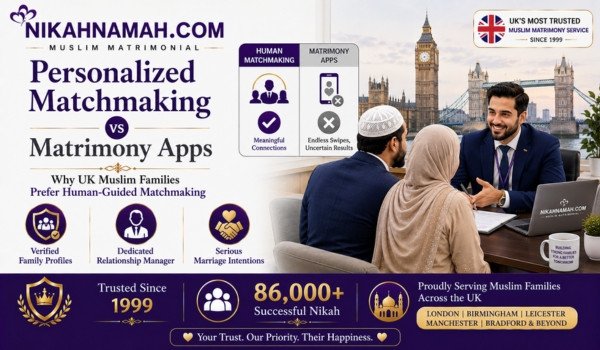
By NikahNamah | India's Most Trusted Muslim Matrimony Platform Since 1999
For about a decade, the conversation around Muslim matrimony in the UK has been dominated by apps – Muzmatch (now Muzz), Salams, MyMuslim, and a growing list of others, each promising to solve the same problem: Muslims in the West, scattered across cities and towns, simply don't run into enough fellow Muslims to find a spouse through family networks and the local mosque alone.
That problem is real, and apps deserve credit for naming it honestly. But increasingly, UK Muslim families – particularly those from Indian and broader South Asian backgrounds, where family involvement in marriage isn't an afterthought but the foundation of the whole process – are finding that the app model solves the discovery problem while creating new problems of its own. This piece looks at why, specifically, and what's drawing families back toward a more personalized, relationship-manager-led approach to matchmaking.
The Real Problem Apps Were Built to Solve
It's worth being fair to the apps first, because their founding insight wasn't wrong. Muzmatch's own founders, launching in 2015, identified what they called the "key problem" for the roughly 60-million-strong Muslim community in the West: low density. A Muslim single in London has more options nearby than one in a smaller UK town, but even in London, the practical pool of compatible, marriage-minded Muslims within someone's existing social and family circle is often smaller than people expect – and apps genuinely do expand that pool past geography and immediate social circle, giving access to potential matches across London, Birmingham, Manchester, Leicester, Bradford, and beyond.
For some people, in some circumstances, this works. Muzz alone has facilitated a meaningful number of marriages over the years. The apps are not a hoax. But "this can work for some people" and "this is what most families actually want" turned out to be two different questions – and the gap between them is where personalized matchmaking has found its footing.
The Documented Problems Families Are Running Into
Fake Profiles, Misleading Photos, and Verification Gaps
A recurring, well-documented complaint about Muslim matchmaking apps is the prevalence of fake or misleading profiles – photos that don't match reality, dishonest information about background, education, or marital status, and a general verification gap that puts the burden of due diligence entirely on the individual user, often with limited tools to actually verify what they're being told. For a family used to vetting a proposal through extended networks – relatives, community connections, mutual acquaintances – this lack of built-in verification feels like a significant step backward, not forward.
Swipe Culture Creeping Into a Process That's Supposed to Be About Character
Several reviewers and users of these apps have noted a specific tension: Islamic teaching emphasizes character and faith (deen) as the basis for marriage, but the swipe-based interface design of most apps – browsing dozens or hundreds of profiles, judging primarily on a photo and a few lines of text – inevitably encourages a more superficial mode of evaluation, with users left wondering if someone "better" is just one more swipe away. This isn't a moral failing of individual users; it's closer to a structural mismatch between what the apps are designed to optimize for and what families say they actually want from the process.
Users Who Aren't Genuinely Ready for Marriage
A frequently repeated frustration, particularly among users describing themselves as serious about marriage, is encountering a meaningful number of profiles belonging to people who aren't actually ready to commit – people exploring, people who joined casually, or people whose stated intentions don't match their actual behaviour once a conversation starts. For families investing real time and emotional energy into a match, discovering midway through that the other person was never seriously looking is a frustrating and avoidable cost.
Real Concerns About Who Owns the Platform and the Data
The Muslim matchmaking app space has also seen genuine controversy around ownership and trust. Salams, a Muslim dating and marriage app with millions of users, was quietly acquired by Match Group – the company behind Tinder, Hinge, and a large portfolio of mainstream dating apps – in a deal that only became public well after it closed, prompting calls for boycotts once users learned of it. Separately, Muzmatch rebranded to Muzz after losing a UK trademark infringement lawsuit in 2022. For families entrusting something as significant as a marriage search to a platform, this kind of behind-the-scenes ownership churn and lack of transparency understandably raises questions about whose interests the platform is actually serving.
A Mismatch With How Marriage Decisions Are Actually Made in Most Indian Muslim Families
Perhaps the most fundamental gap: most apps are built around an individual user's profile, swipes, and direct messaging – a model borrowed from general dating apps and adapted for a Muslim audience, sometimes including a "wali" (guardian) feature as an add-on rather than a foundation. But for many Indian Muslim families in the UK, marriage isn't an individual's solo project with family informed afterward – it's a family undertaking from the start, with parents, siblings, and sometimes the wider extended family playing an active role in vetting, discussing, and deciding. An app interface designed around one person swiping alone doesn't naturally accommodate this, even when individual features are bolted on to try.
What Personalized Matchmaking Actually Provides Instead
A Human Relationship Manager Who Does the Vetting Apps Can't
Where an app puts verification largely on the user, a Relationship Manager-led service does the vetting directly – speaking with both the individual and, typically, their family, reviewing documentation where relevant (education, profession, immigration status for UK-based profiles), and forming a genuine, considered view of compatibility before presenting a match. This doesn't eliminate the need for families to do their own due diligence, but it means they're not starting from zero with an unverified profile.
A Process Built Around Family Involvement From the Start
A personalized matchmaking service naturally accommodates parents and family being part of the conversation from day one – exactly the structure most Indian Muslim families expect marriage decisions to follow – rather than treating family involvement as an awkward retrofit onto an individually-designed app experience.
Fewer, More Considered Matches Instead of an Infinite Swipe Queue
Rather than presenting an endless stream of profiles optimized for quick browsing, a Relationship Manager typically curates a smaller number of genuinely considered matches based on a deeper understanding of both parties – values, life stage, family expectations, and practical factors like location, profession, or (for UK-specific cases) immigration status – addressing directly the "character over photo" concern that the swipe model struggles with.
Continuity and Accountability From a Known Service
A long-established matrimony service with a multi-decade track record offers something an app, however large its user base, structurally cannot: a continuous, accountable relationship with a known organisation – not a platform that can be quietly bought, sold, or rebranded without users finding out until after the fact.
Real Stories: UK Families Who Moved From Apps to NikahNamah
Story 1: The Birmingham Family – When Endless Swiping Led Nowhere
Aisha was 27, working in marketing in Birmingham, from a Hyderabad-origin Muslim family. She had spent the better part of two years on one of the major Muslim matchmaking apps, having dozens of conversations that fizzled out, several profiles that turned out to be significantly misrepresented, and a growing sense of fatigue with the entire process.
"I'd matched with maybe forty people over two years and had three actual phone calls that went anywhere," Aisha said. "Looking back, I think the volume was the problem, not the solution. I was evaluating people on three sentences and a photo, and so was everyone evaluating me."
Her mother, increasingly concerned, suggested approaching NikahNamah instead. The Relationship Manager's first conversation was markedly different: detailed questions about Aisha's values, her family's expectations, what she'd learned from the app experience about what didn't work for her – and then a much smaller number of specifically considered introductions, with the RM having spoken directly to each family beforehand.
"It felt like the difference between being handed a phone book and being introduced by someone who'd actually thought about whether we'd suit each other," Aisha said. The match, within four months, was with a Leicester-based Indian Muslim family whose son had had a similar experience trying matchmaking apps before turning to a personalized service.
Story 2: The Leicester Family – When Family Involvement Made the Difference
The Hussain family in Leicester had encouraged their son Bilal, 30, to try a matchmaking app, reasoning that "everyone does it now." Bilal did, for several months, but found the experience oddly isolating – he was managing the entire process alone, reporting back to his parents only after conversations had already progressed, which left his mother in particular feeling shut out of a decision the family considered to be a shared one.
"It's not that I didn't want to involve them," Bilal said. "It's that the app simply wasn't built for that. There was no natural way to bring my mum into a conversation happening in a chat window."
Switching to NikahNamah changed the structure of the process itself: the Relationship Manager spoke with Bilal's mother directly as part of building his profile, and every potential match was discussed as a family conversation before Bilal himself engaged further. "It felt like the process matched how we actually wanted to make this decision," his mother said. "Not an app he used by himself and told us about afterward."
Story 3: The London Professional – When Verification Actually Mattered
Yusuf, 32, a finance professional in London, had a particularly frustrating app experience: a promising conversation with a woman whose profile claimed a specific profession and education background, which turned out, after several weeks, to be substantially inaccurate. "There was no real way to check any of it beforehand," Yusuf said. "I just had to take it on faith, and the faith turned out to be misplaced."
When he approached NikahNamah afterward, the difference in process was immediate: the Relationship Manager discussed his own background and credentials in detail and, with appropriate consent, did the same with prospective matches' families before introductions were made. "It wasn't about distrust," Yusuf said. "It was about someone doing the basic groundwork that an app interface simply has no mechanism to do."
Testimonials: UK Muslim Families on Choosing Personalized Matchmaking
"Two years on an app got me dozens of conversations and almost nothing real. NikahNamah's RM had actually thought about whether we'd suit each other before introducing us. That's a completely different experience." – Marketing Professional, Birmingham
"The app had no way to bring my family into the process naturally. NikahNamah's RM spoke to my mother directly from the start. That made it feel like the decision we'd always intended marriage to be – a family one." – Groom, Leicester
"I'd taken someone's claimed background on faith because the app gave me no way to check it, and it turned out to be wrong. NikahNamah actually does that groundwork. That's not old-fashioned – it's just more careful." – Finance Professional, London
"After hearing about apps being bought and sold without users even knowing, I wanted something more accountable. A platform with 27 years of history and an actual person managing the process gave me that." – Bride's Family, Manchester
How NikahNamah Serves UK-Based Indian Muslim Families
We assign a Relationship Manager who does real vetting. Background, education, profession, and (where relevant) UK immigration status are discussed directly and verified to the extent possible, rather than left to an unverified self-reported profile.
We build the process around family involvement, not around it. Parents and family are part of the conversation from the outset – the structure most Indian Muslim families expect marriage decisions to follow – rather than a feature added on top of an individually-designed interface.
We present fewer, more carefully considered matches. Rather than an endless browsing queue, our Relationship Managers curate introductions based on genuine compatibility assessment – values, life stage, family expectations, and practical UK-specific factors.
We offer continuity and accountability. As an established service with a long track record, families work with a consistent, accountable organisation – not a platform that can change hands or rebrand overnight, as has happened in the matchmaking app space.
We serve UK-based Indian Muslim families across England, Scotland, and Wales. From London and Birmingham to Leicester, Manchester, Bradford, and beyond, with the same Relationship Manager-led, family-centred approach throughout.
For Families in the UK: What to Consider
Apps genuinely solve a real geographic and density problem – for some people, in some circumstances, expanding the pool of potential matches beyond an immediate social circle is valuable, and this shouldn't be dismissed outright.
But apps were built on a general-dating-app model, adapted for Muslims – and several structural features of that model (swipe-based browsing, individual-only profiles, limited verification) sit uneasily alongside how many Indian Muslim families actually want to approach marriage.
Verification matters more than it might seem at first – documented, repeated complaints about fake or misleading profiles across these platforms suggest this isn't a rare edge case but a structural gap worth taking seriously.
Family involvement is either built in or it isn't – if a family expects to be part of the process from the start, it's worth choosing a matchmaking approach that's actually structured for that, rather than retrofitting family involvement onto a tool designed for individual use.
Ownership and accountability are real considerations – knowing who owns a platform, how long it's operated, and what its track record looks like is reasonable due diligence for something as significant as a marriage search.
Frequently Asked Questions: Apps vs. Personalized Matchmaking in the UK
Q: Are Muslim matchmaking apps inherently bad or untrustworthy? Not inherently – they were built to solve a genuine problem (low density of marriage-minded Muslims in many Western cities and towns) and have facilitated real marriages. The concerns are more structural: limited verification, a swipe-based design that can encourage superficial evaluation, documented issues with fake or misleading profiles, and ownership changes (such as Salams' acquisition by Match Group) that have raised trust questions for some users.
Q: Why are more UK Indian Muslim families specifically moving away from apps? A recurring theme is that the app model is built around individual users, while many Indian Muslim families expect marriage decisions to be a family process from the start. Apps also place the burden of verifying a match's claims largely on the individual, with limited built-in tools to check accuracy – a gap families used to community-based vetting find frustrating.
Q: What does a Relationship Manager actually do that an app doesn't? A Relationship Manager has direct conversations with both the individual and (typically) their family, discusses and where possible verifies background details, and curates a smaller number of genuinely considered introductions based on compatibility – rather than presenting an unfiltered, self-reported profile for the user to evaluate alone.
Q: Is personalized matchmaking slower than using an app? It can involve a more deliberate pace upfront – building a proper profile and understanding a family's expectations takes time – but many families find this results in fewer, more meaningful introductions rather than a larger volume of unproductive conversations, which can ultimately be faster to a genuine match.
Q: Can someone use both an app and a personalized matchmaking service? Some people do explore both, and there's no inherent conflict. What matters is being clear-eyed about what each approach is actually good at: apps for expanding initial geographic reach, personalized matchmaking for vetting, family involvement, and curated compatibility assessment.
Choosing the Approach That Actually Fits How Your Family Marries
The shift many UK Indian Muslim families are making isn't a rejection of technology or modern convenience – it's a recognition that the swipe-based, individual-profile app model, however well-intentioned, doesn't naturally fit how marriage decisions are actually made in most South Asian Muslim families. Personalized matchmaking, with a Relationship Manager who genuinely vets, curates, and includes family from the start, addresses exactly the gaps that apps have struggled with.
At NikahNamah, we provide exactly this – specifically, honestly, and with the particular care that finding a genuine life partner deserves, built on 27 years of NRI matrimony service.
Register for free on NikahNamah today. Whether you're in London, Birmingham, Leicester, or anywhere across the UK – and whether you've tried apps before or are starting your search fresh – speak with our team. Some things are still better done with a person who's genuinely paying attention, not an algorithm optimizing for engagement.
May Allah bless every UK Muslim family seeking the right life partner – guiding them past the noise toward genuine compatibility – and write for each of them a Nikah that brings the companion who is genuinely, specifically, joyfully right for the life they are building. Ameen.
Also Read on NikahNamah Blog
- Muslim Matrimony in the UK: Finding the Right Life Partner for Nikah
- USA Based Muslim Grooms: Premium Matchmaking Services
- Germany Based Muslim Grooms: Premium Matrimony Services
- Muslim Matrimony in Australia: A Complete Guide for Families
- Finland Based Muslim Grooms and Brides: Finding the Right Match
- Explore all NRI Muslim matrimony guides
About NikahNamah
NikahNamah is India's #1 Muslim Matrimony platform, trusted since 1999. With over 86,000 successful Nikah completed and 96,461+ registered members across India, UAE, Saudi Arabia, Qatar, Kuwait, UK, USA, Canada, Australia, Germany, and beyond – we serve UK-based Indian Muslim families with the human, accountable, family-centred matchmaking approach that a genuine marriage search deserves.
📍 Main Branch: Jayanagar 9th Block, Bengaluru – 560069 📍 Other Branch: Frazer Town, Bengaluru – 560005 📞 +91 98451 30331 | +91 90360 22522 🌐 www.nikahnamah.com | ✉️ support@nikahnamah.com ⏰ Monday to Sunday, 10:00 AM – 8:00 PM IST (Friday Off)

💬 Comments