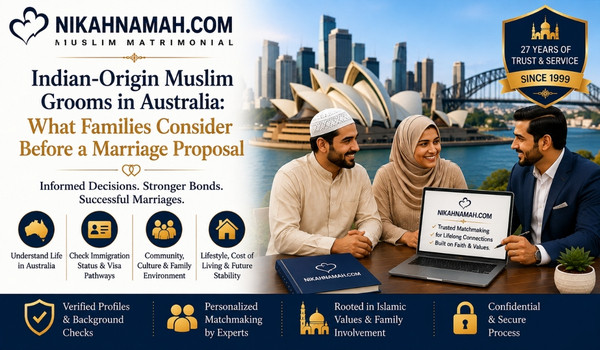
By NikahNamah | India's Most Trusted Muslim Matrimony Platform Since 1999
The letter arrives - or in the modern version, the matrimony platform notification, the family friend's call, the WhatsApp message from a relative - and a family in India begins evaluating a proposal from an Indian Muslim groom living in Australia.
The first response is often a complicated mix. There is genuine interest - Australia is known to be an excellent country, and the groom's profile reads well. There is also genuine uncertainty - not quite anxiety, but the specific uncertainty that comes from evaluating something that is real but unfamiliar. The family knows the Gulf well enough to evaluate a Dubai or Riyadh proposal. They know the USA well enough to ask the right questions. Australia is different - known to be good, but not known in the specific, granular way that allows genuinely confident evaluation.
This guide addresses the specific things that families in India consider - or should consider - before accepting a marriage proposal from an Indian-origin Muslim groom living in Australia. It does not present a checklist of reasons to accept or refuse. It provides the specific, honest information that allows families to evaluate with genuine knowledge rather than with general impressions or media-shaped assumptions.
The First Question Every Family Asks: Where in Australia?
This question is more important than it sounds. Australia is a continent-sized country. Melbourne and Perth are 2,700 kilometres apart. Sydney and Brisbane are 900 kilometres apart. The city the groom lives in shapes everything that follows: the Indian Muslim community available to the bride, the halal food infrastructure, the mosque accessibility, the social world, the climate, and the specific professional economy in which the groom has built his career.
A family in India that simply thinks "Australia is good" without evaluating "which Australian city specifically" is doing only half the due diligence the proposal deserves.
What families should understand about each major city:
Melbourne: The most established Indian Muslim community in Australia outside Sydney. The southeastern suburbs - Dandenong, Springvale, Noble Park - have significant South Asian Muslim populations with comprehensive halal food, mosque access, and community infrastructure. Melbourne's climate: genuinely cold in winter (not Finnish cold, but genuinely cold by Indian standards - average lows of 6-7°C in winter), with four distinct seasons. Melbourne has a rich cultural life, excellent public transport, and consistently high livability scores.
Sydney: A large, cosmopolitan city with a significant Indian Muslim community concentrated in the inner southwestern suburbs (Lakemba, Auburn) and spreading across Parramatta, the Hills District, and other suburban areas. Sydney's climate is warmer than Melbourne's (average winter lows around 9-10°C). Sydney is one of the world's most expensive cities - housing costs in particular are significant.
Brisbane: A warmer, less expensive, and more rapidly growing city than Melbourne or Sydney. The Indian Muslim community in Brisbane is smaller and newer than in the east coast capitals, but growing. Brisbane's subtropical climate (genuinely warm, including in winter) is a transition that many Indian-origin families find easier than Melbourne's or Sydney's cold winters.
Perth: Australia's most remote major city (2,700km from Melbourne, the closest east coast capital). Perth's Indian Muslim community is smaller than the east coast cities but has a genuine character shaped by Western Australia's mining and resources economy. Perth's climate is Mediterranean - warm, dry summers and mild winters. The remoteness from the east coast creates a tighter-knit Indian community than in larger cities.
Adelaide: A smaller, more affordable city than Melbourne or Sydney. The Indian Muslim community is smaller but genuine. Adelaide's Mediterranean climate, its wine country surroundings, and its lower cost of living make it genuinely appealing, though the smaller community infrastructure requires adjustment.
The Second Question: The Groom's Immigration Status
Understanding the groom's immigration status - and what it means for the bride's visa pathway - is one of the most important practical evaluations a family in India needs to make. The status determines the timeline and the structure of the bride's journey to Australia.
The Four Main Status Situations
Australian Citizen: The most stable status. The bride applies for an offshore Partner Visa (Subclass 309, temporary, then Subclass 100, permanent after approximately 2 years from application). Australian citizens' partners are well-supported through the partner visa system. The processing timeline for the initial 309 is variable - families should check current processing times at immi.homeaffairs.gov.au.
Key consideration: Despite being the partner of an Australian citizen, the bride is on a temporary visa during the initial processing and for approximately 2 years after. During this period, she has full work rights in Australia.
Australian Permanent Resident (not yet citizen): The visa pathway for the bride is identical to the citizen scenario - 309/100 (offshore). The key difference is the groom's own status: permanent residents can become citizens after meeting the residence requirements (generally 4 years of lawful residence including 1 year as a PR). The bride should understand that the groom is on a pathway to citizenship, not there yet.
Skilled Worker Visa (482, Subclass) - Employer-Sponsored: The groom is in Australia on an employer-dependent temporary visa, typically working toward permanent residency through the Employer Nomination Scheme (ENS, Subclass 186). This situation is analogous to the American H-1B. The partner visa for the bride can be applied for, but the groom's own temporary status means the bride's initial visa is temporary and the groom's permanent residency (and therefore the bride's permanent pathway) is contingent on the employer sponsorship progressing.
Student or Post-Study Visa: Some grooms are in Australia on student visas (Subclass 500) or post-study visas (Subclass 485). A marriage proposal from someone on a student or post-study visa should be evaluated with the understanding that their Australian stay is temporary and their long-term pathway to permanent settlement has not been established. Families should evaluate carefully whether the groom's pathway to permanent settlement in Australia is clear and realistic.
The Third Question: The Partner Visa Reality
Australian matrimony for Indian families has one specific, non-negotiable reality that families must understand before they engage seriously with a proposal: the Australian Partner Visa is a two-stage process, and the permanent stage comes approximately two years after the initial application.
What This Actually Means in Practice
After the Nikah in India: The bride applies for the offshore Partner Visa (Subclass 309) from India. This application requires evidence of a genuine marriage: the Nikah certificate (and a civil marriage registration if applicable), financial evidence of the relationship, photographs, statements from both parties, and other relationship evidence. The application fee for Partner Visas is significant - check the current Department of Home Affairs fee schedule.
Processing time for the 309: Variable. The Department of Home Affairs' current processing times for Subclass 309 applications are published at immi.homeaffairs.gov.au. In recent years, processing has taken anywhere from 12 months to 28 months or longer. This means the bride may be waiting in India for one to more than two years after the Nikah before the temporary visa is granted.
After the 309 is granted: The bride can travel to Australia and begin her life there. She has full work rights on the 309 temporary visa. She is not yet a permanent resident.
The 100 (permanent) visa: Approximately 2 years after the initial Partner Visa application was lodged, the permanent Subclass 100 visa is assessed. By this point, the couple must demonstrate that the marriage remains genuine. If it does (and for genuine marriages, this is not a significant concern), the 100 permanent visa is granted.
The total timeline: For a bride who marries an Australian permanent resident or citizen, the full journey from Nikah to permanent residence is approximately 2-3+ years (application processing time plus the 2-year requirement). During most of this time after arrival in Australia, the bride has full work rights and a stable temporary visa.
Families should plan for this honestly. A bride who enters the marriage expecting quick permanent settlement and discovers a multi-year temporary visa period may find the experience more difficult. A bride who enters with genuine understanding of the timeline - and who sees the temporary period as the beginning of the permanent Australian life, not a barrier to it - navigates it more successfully.
The Fourth Question: Islamic Life in Australia
For a practicing Indian Muslim family, the question of how Islamic practice is sustained in Australia is central to evaluating any Australian proposal. The honest answer is: genuinely possible, and requiring deliberate effort.
Mosques: Australia's major cities have mosques serving their Muslim communities. Melbourne has several significant mosques (including the well-known Islamic Museum of Australia, which is adjacent to a major mosque in Werribee). Sydney's Auburn mosque is one of Australia's largest. Brisbane, Perth, and Adelaide each have mosques serving their communities. The mosque accessibility varies by suburb - a bride moving to a suburb well-served by a mosque will find Friday prayer straightforward; a bride in a more suburban or remote location may have a longer commute to the mosque.
Halal food: In Melbourne and Sydney, halal food is readily available - not just in Indian and Middle Eastern restaurants, but in certified halal butchers and supermarkets. In Brisbane and Perth, the halal food infrastructure is good in areas with significant Muslim populations. In Adelaide, halal food is available but requires more deliberate sourcing in some areas.
Islamic schools: Several Australian cities have established Islamic schools - schools that provide Islamic education alongside the Australian curriculum. Melbourne and Sydney have the most options. For families thinking about raising children in Australia, the Islamic school option is a genuine one in the major east coast cities.
The Ramadan community: Australia's Muslim communities observe Ramadan with community iftars, tarawih prayers, and the specific communal energy that the month produces. For an Indian bride who has grown up in an Indian Muslim community where Ramadan is a shared social experience, Australia's Ramadan has its own specific character - smaller, more intimate, but genuine.
The deliberate practice dimension: The fundamental reality of Islamic practice in Australia is the same as in the UK, the USA, or Germany - it requires deliberate, personally owned commitment. The environment does not reinforce the practice. The practice must come from the person. For families assessing Islamic practice compatibility, the right question is not whether the groom says he practices, but whether his practice is genuinely demonstrated, visible, and consistent. A premium matchmaking service's deen assessment addresses this specifically.
The Fifth Question: Community and Social Life
An Indian bride moving to Australia leaves behind the specific social world she has built in India - her family, her friends, her mosque community, her neighbourhood. What does she find when she arrives?
The honest answer varies by city and by suburb. In Melbourne's southeastern suburbs and Sydney's southwestern suburbs, an Indian bride entering an established Indian Muslim community will find a genuine and active social world - other Indian Muslim women, community events, mosque programmes, and the specific social bonds that form within diaspora communities that have built real community life.
In Brisbane, Perth, or Adelaide - or in suburbs of Melbourne and Sydney that are farther from the established Indian Muslim concentrations - the social world the bride enters will be smaller and require more deliberate community-building.
What families should ask:
- Which suburb does the groom live in, and what is the Indian Muslim community infrastructure in that suburb?
- Is the groom's family in Australia? (A bride whose mother-in-law is in Australia has immediate family support; a bride who is the first in an entirely nuclear household has less immediate family context.)
- Does the groom have a social and community life, or does he live an isolated professional life with no community engagement?
Families in India who ask these specific questions receive information that allows genuine evaluation rather than general impression.
The Sixth Question: The Australian Lifestyle Adjustment
Australia has a specific lifestyle character that an Indian bride will encounter and that deserves honest anticipation.
The outdoors orientation: Australians are genuinely outdoors-oriented - the beach, the bush, the parks, the outdoor spaces that Australian cities offer. For an Indian bride from a city like Hyderabad or Bangalore where outdoor public life is genuinely warm-weather activity, Australia's outdoor culture requires some adjustment - more outdoor activity, more engagement with public spaces, a social life that often happens outdoors rather than in enclosed family or community settings.
The informality: Australian social culture is noticeably less formal than Indian urban professional culture. The workplace is less hierarchical. Social relationships form through shared activities rather than through formal introductions. For an Indian bride accustomed to Indian professional and social formality, the Australian informality can feel welcoming or disorienting, depending on temperament.
The domestic structure: In Australian professional households, the expectation of shared domestic responsibility - cooking, cleaning, household management - is more explicit than in traditional Indian household structures where domestic roles are more defined. A bride who enters with awareness of this will navigate the Australian household culture more easily than one who discovers it as an unexpected adjustment.
The halal food sourcing: Even in cities with good halal food infrastructure, daily life with halal food in Australia requires more deliberate sourcing than in India. Halal-certified butchers, reading ingredient labels, choosing restaurants carefully - these are routine activities for Australian Muslim families but require adjustment for brides who are accustomed to halal being the ambient default.
What Good Families Ask During Proposal Evaluation
Based on NikahNamah's experience with hundreds of Australia-India matrimony searches, here are the questions that the most thoughtful families in India ask when evaluating an Australian proposal:
About the groom:
- What is his specific immigration status, and what is the timeline to the partner visa and to permanent residence?
- What does his Australian community and social life look like - does he have community connections and mosque engagement, or does he live entirely isolated professionally?
- What is his total compensation picture (not just base salary - including superannuation, any equity or bonus components)?
- Has he visited India recently, and what is his commitment to annual India visits?
About the city and suburb:
- Which city and which suburb specifically, and what is the Indian Muslim community infrastructure in that suburb?
- How far is the nearest mosque from his home?
- What is the halal food situation in his area?
- Is his family in Australia or in India?
About the bride's life in Australia:
- What professional opportunities would the bride have (her own qualification and career pathway in Australia)?
- Are there Indian Muslim women in the groom's social circle who could be community for the arriving bride?
- Does the groom have a realistic plan for the bride's adjustment period - community introductions, language support (if needed), settlement support?
About the partner visa:
- Has the family received specific, honest information about the partner visa timeline (309 offshore, approximately 12-28+ months processing, followed by 2-year wait for 100 permanent)?
- Is the family genuinely at peace with the multi-year temporary visa period?
Real Stories: Families Who Evaluated Australian Proposals
Story 1: The Family That Asked All the Right Questions
A Muslim family in Hyderabad received a proposal for their daughter from an Indian Muslim groom in Melbourne - a 34-year-old IT professional, Australian permanent resident, from a South Indian Muslim family. The family was interested. They were also thorough.
Through NikahNamah's Relationship Manager, they asked every question worth asking. The suburb (Springvale - well within Melbourne's established Indian Muslim community). The nearest mosque (within walking distance). The halal food (multiple halal butchers in the suburb). The groom's social life (regular mosque attendance, a South Indian Muslim community group, a small circle of Indian Muslim friends). The partner visa timeline (current 309 processing estimate of 15-18 months, followed by the 2-year 100 wait - communicated specifically and honestly).
They took three weeks to evaluate. They discussed the partner visa timeline specifically within the family. The mother visited an Australia immigration lawyer's website to verify the visa information they had been given. They asked the RM to arrange a video call with the groom's family.
When they said yes, they said it with full, genuine knowledge. The conversation after the yes was about the wedding planning, not about anxieties that had not been addressed.
"We felt respected by the process," the mother said. "Every question we asked was answered specifically and honestly. We did not feel that we were being managed toward a yes. We felt that we were being given the information to decide for ourselves."
Story 2: The Family That Initially Said No - and Then Said Yes
A Muslim family in Bangalore received a proposal from an Indian Muslim groom in Sydney - a 31-year-old engineer, Australian citizen, from a Karnataka Muslim family. Their initial response was hesitation - they knew Sydney was far, they were uncertain about the partner visa timeline, and they had a vague concern about Islamic practice in Australia.
Rather than dismissing the proposal or pursuing it without full information, they asked NikahNamah for the complete picture before deciding.
The RM provided it. The specific suburb (Parramatta). The mosque (the Parramatta Mosque, one of Sydney's significant mosques). The halal food infrastructure (comprehensive in Parramatta). The partner visa timeline (specifically: Australian citizen sponsor, current 309 processing estimate, the 2-year 100 wait). The groom's Islamic practice (specifically assessed through sustained conversation with his family and through community knowledge of their Muslim community in Karnataka - genuine, consistent, personally owned).
The family reconsidered with this specific information. The hesitation about Islamic practice was addressed by the specific assessment of the groom's practice. The hesitation about the partner visa was addressed by the honest timeline information - which, once fully understood, they found genuinely acceptable rather than alarming.
They said yes. With specific knowledge. The yes they said was informed and therefore stable.
"We almost said no based on general uncertainty," the mother said. "The RM gave us the specific information that allowed us to evaluate specifically. The specific evaluation found that our concerns were addressable. The general uncertainty would have cost us the right match."
How NikahNamah Guides Families Through Australian Proposal Evaluation
We provide the complete, city-specific, status-specific picture. For every Australian proposal, we present: the specific city and suburb (with its Indian Muslim community infrastructure), the groom's immigration status (explained specifically), the partner visa timeline (current estimates, both stages, work rights during temporary status), the Islamic practice assessment (specifically evaluated, not just stated), and the specific quality of life picture for that suburb and city.
We answer every question families ask - specifically and honestly. The families who feel most confident at the end of the evaluation process are those who were given complete, honest information and who were encouraged to ask every question they had. We provide this.
We give families time to evaluate. A family that needs three weeks to think through an Australian proposal receives three weeks. The right decision is made with the right time for consideration, not under pressure.
We arrange direct family calls with the groom's family. For families who want to speak directly with the groom's family in Australia before deciding, we facilitate these calls - at times that work across the time zone gap.
We do not manage families toward yes. The families who say yes with specific, genuine knowledge are the families whose marriages begin well. A family that says yes under managed pressure discovers the realities they were not given as surprises - and the marriage begins under that shadow.
Frequently Asked Questions: Families Evaluating Australian Proposals
Q: Our daughter will be far from family in Australia. What is the realistic expectation for family visits?
Realistic expectations: the bride will likely visit India once per year (during school holidays if children are involved, or based on leave entitlements otherwise), and the Indian family will ideally visit Australia once or twice during the initial settlement years to support the daughter's adjustment. Australia-India flights are available from all major Australian cities, typically with one connection (through Singapore, Doha, Dubai, or Abu Dhabi), and are genuinely manageable for families who budget for them annually. The time zone gap (AEST is 4.5-5.5 hours ahead of IST, depending on season) is significant but manageable for regular video calls - Australian evenings correspond to IST mid-day to afternoon, making regular family video calling straightforward.
Q: We are concerned that our daughter will not have Islamic community support in Australia. How do we assess this?
By asking specific, granular questions about the specific suburb the groom lives in: How far is the nearest mosque? Does the groom attend Friday prayer regularly? What is the halal food availability in the specific suburb? Is there an Indian Muslim women's community or social circle that the bride could join? NikahNamah's Relationship Manager provides this suburb-level Islamic infrastructure information as part of the standard Australian proposal presentation.
Q: My daughter is a qualified professional (doctor, engineer, teacher, etc.). Will she be able to work in Australia?
This depends on the specific profession. Some Indian qualifications are recognised in Australia with or without additional examination; others require a formal skills assessment through Australian registration bodies (for doctors, the Australian Medical Council; for nurses, the Australian Health Practitioner Regulation Agency; for engineers, Engineers Australia; for teachers, the Australian Institute for Teaching and School Leadership - each state has its own teacher registration body). Before the marriage, families should research the specific qualification recognition pathway for the bride's profession. NikahNamah's Relationship Manager can provide general guidance and direct families to the appropriate professional registration bodies for specific advice.
Q: We have heard that Australia's partner visa processing is very slow. Is this still the case?
Partner visa processing times in Australia have historically been variable - sometimes running to 18-24 months or longer for offshore applications. This is the honest reality that families should plan for. The specific current processing times are published at immi.homeaffairs.gov.au and change with the Department of Home Affairs' operational capacity. We strongly encourage families to check the current processing estimates directly on this website rather than relying on anecdotal information. A registered Australian migration agent or immigration lawyer can provide specific advice on the current situation and any strategies to optimise the application.
Q: How does NikahNamah ensure that the groom's Islamic practice is genuine, not performed for matrimony purposes?
Through sustained, specific assessment that goes beyond the stated profile. The Relationship Manager has extended conversations with the groom's family about the nature and consistency of Islamic practice in the household. She asks specific questions about prayer, about halal food observance, about mosque attendance, about how Islamic practice has been maintained through the specific secular environment of Australian professional life. She also draws on community knowledge where available - the reputation of the family's practice within their Australian community or their Indian community provides independent verification. Practice that is genuinely maintained produces consistent, specific answers across multiple conversations. Practice that is nominal or performed produces different signals.
The Honest Evaluation Is the Best Beginning
A marriage that begins with the bride's family having genuinely evaluated the proposal - having asked every question worth asking, having received specific, honest answers, and having made their decision with complete information - is a marriage that begins well.
A marriage that begins with the bride's family having accepted the proposal based on general impressions, with anxieties that were not addressed because they were not asked, or with information that was managed rather than complete - this is a marriage that begins with unresolved questions. And unresolved questions are the seeds of later difficulty.
The families who evaluate Australian proposals most effectively are the families who treat the evaluation with the same seriousness that the decision deserves. They ask about the suburb, not just the country. They ask about the immigration timeline, not just the immigration status. They ask about the mosque, not just whether the groom is practicing. They ask about the halal food, not just whether Australia has it. They ask about the community, not just whether there is one.
At NikahNamah, we support this serious evaluation entirely. We provide the specific information. We answer the specific questions. We give families the time to decide genuinely. And we understand that the right yes - made with complete, specific knowledge - is worth far more than the fast yes made under general impressions.
Register for free on NikahNamah today. For families in India evaluating Australian proposals - or for Australian grooms ready to conduct a premium matchmaking search - speak with our team. The evaluation, done well, is the beginning of everything.
May Allah give every family in India the specific wisdom, the specific information, and the specific patience to evaluate the proposals that come to their daughters with the full care that the decision deserves - and write, through this careful evaluation, the Nikah that is genuinely, specifically right. Ameen.
Also Read on NikahNamah Blog
- Muslim Matrimony in Australia: A Complete Guide for Families
- NRI Muslim Grooms with International Degrees: Complete Matrimony Guide
- How Muslim Families in India Choose USA Based Grooms with H1B or Green Card
- Why Visa Status Matters in Muslim Matrimony for USA Based Grooms
- Muslim Matrimony in the UK: Finding the Right Life Partner for Nikah
- Finding the Right Muslim Life Partner in South Africa
- How Families Can Choose the Right Muslim Matrimony Platform
- The Importance of Compatibility in Nikah: Why It Goes Beyond Looks and Income
About NikahNamah
NikahNamah is India's #1 Muslim Matrimony platform, trusted since 1999. With over 86,000 successful Nikah completed and 96,461+ registered members across India, UAE, Saudi Arabia, Qatar, Kuwait, UK, USA, Canada, Australia, and beyond - we guide families in India through the complete, honest evaluation of Australian matrimony proposals, providing the city-specific, visa-timeline-specific, Islamic-practice-specific information that genuine evaluation requires.
📍 Main Branch: Jayanagar 9th Block, Bengaluru – 560069 📍 Other Branch: Frazer Town, Bengaluru – 560005 📞 +91 98451 30331 | +91 90360 22522 🌐 www.nikahnamah.com | ✉️ support@nikahnamah.com ⏰ Monday to Sunday, 10:00 AM – 8:00 PM IST (Friday Off)

💬 Comments